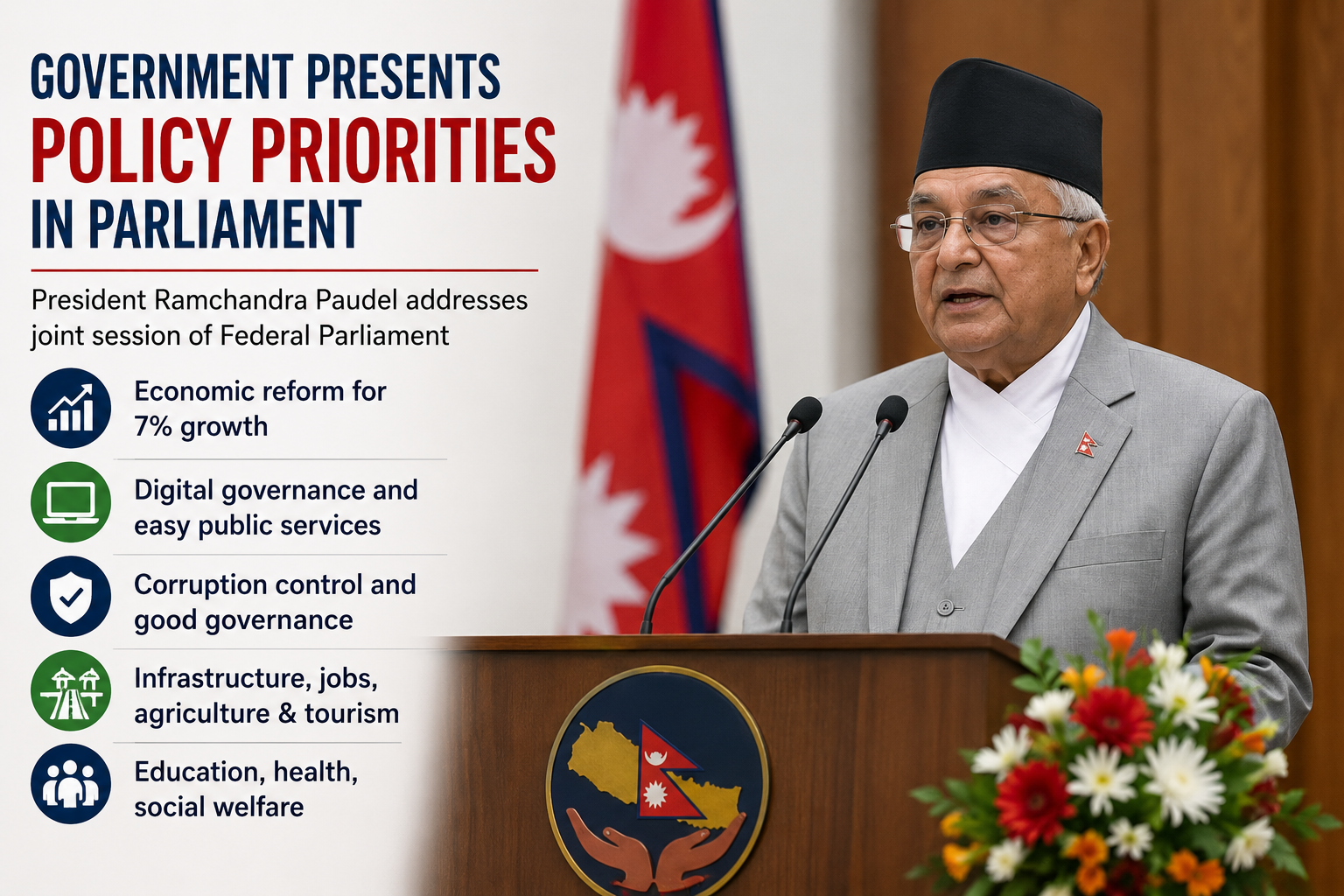
President Ramchandra Paudel addressed the joint meeting of both houses of the Federal Parliament on Baisakh 28, 2083, on behalf of the government formed after the House of Representatives election held on Falgun 21, 2082. The address emphasized political stability, good governance, corruption control, public service reform, economic revival and social progress as the government’s key priorities.
The government has announced a new phase of economic reform aimed at achieving an average real economic growth rate of 7% over the coming decade. The policy priorities include simplifying the business environment, attracting domestic and foreign investment, digitizing economic transactions, reducing tax burdens, strengthening anti-money laundering systems, reforming cooperatives, improving capital markets and promoting infrastructure financing.
The address also highlights major plans for agriculture modernization, land administration reform, forest and climate action, hydropower development, green industries, tourism promotion, employment generation, education reform, health services, drinking water, roads, public transport and disaster preparedness. It also proposes digital governance reforms such as integrated government databases, citizen app expansion, digital signatures, e-KYC, online services and time-bound decision-making to reduce queues and delays in public services.
The government has also committed to strengthening anti-corruption mechanisms, making public procurement and revenue systems more transparent, publishing annual property details of high-level officials, improving civil service accountability, and implementing the previously announced 100-point governance reform agenda. The President concluded by calling on political parties, civil servants, security agencies, farmers, workers, businesses, civil society and citizens to contribute to Nepal’s overall development.