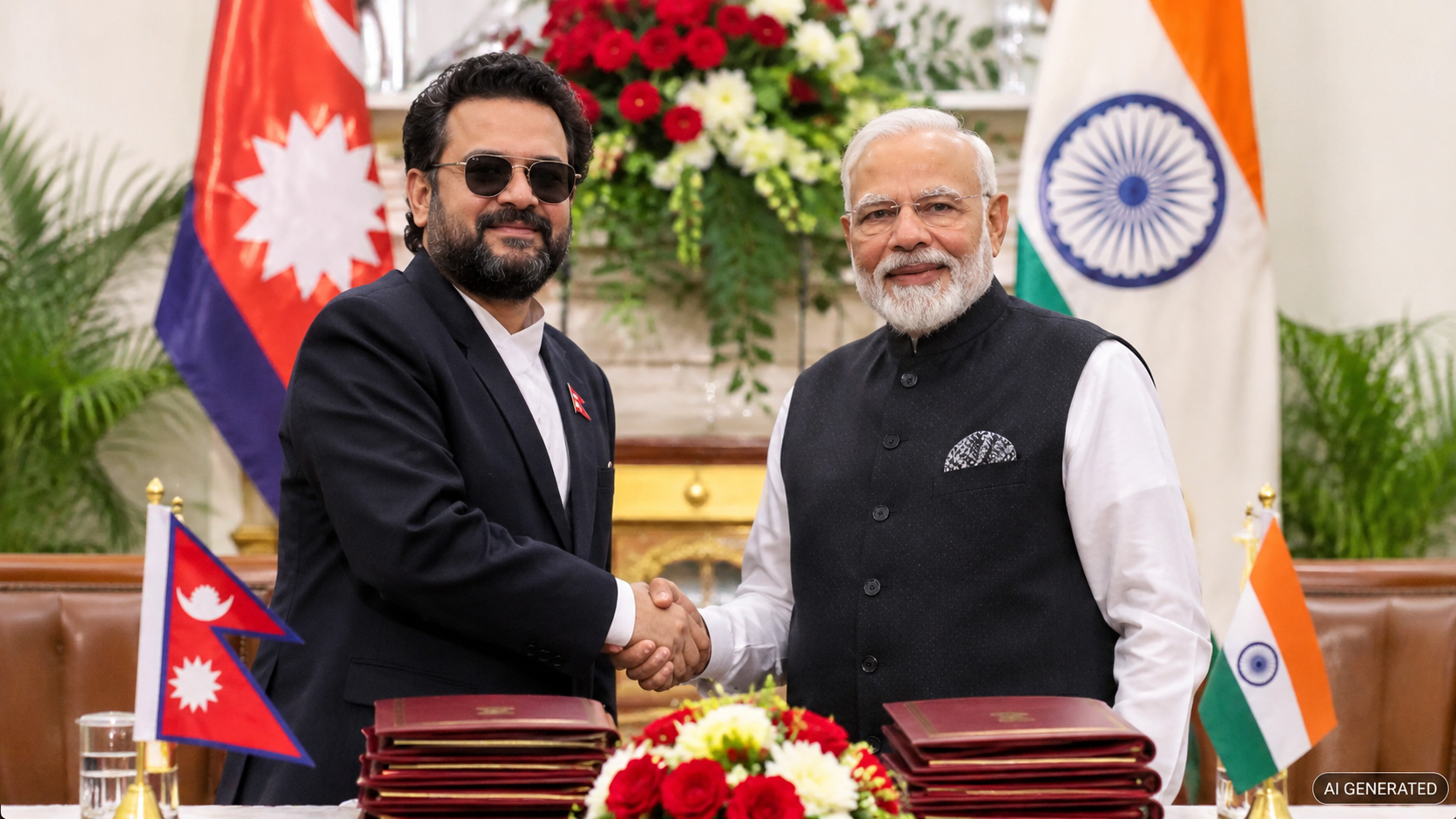
Prime Minister Balendra Shah returned to Kathmandu on Monday evening after completing his two-day state visit to India, during which Nepal and India jointly inaugurated three major infrastructure projects, laid foundation stones for three additional projects and exchanged eight Memoranda of Understanding (MoUs). According to a press release issued by Nepal’s Ministry of Foreign Affairs on November 23, Shah held bilateral talks with Indian Prime Minister Narendra Modi and paid a courtesy call on Indian President Droupadi Murmu at Rashtrapati Bhavan in New Delhi. During the meetings, both leaders reviewed the overall state of Nepal–India relations and exchanged views on matters of mutual interest. Earlier in the day, Shah attended a ceremonial reception at Rashtrapati Bhavan, inspected the Guard of Honour and visited Rajghat to pay tribute to Mahatma Gandhi. Prime Minister Modi also hosted an official luncheon in honour of the visiting Nepali delegation.
A major highlight of the visit was the joint inauguration of three infrastructure and connectivity projects by Prime Ministers Shah and Modi. These included the Darchula–Dharchula Motorable Bridge, connecting Nepal and India through a new cross-border road link; the Janakpur–Ayodhya Passenger Rail Service, intended to strengthen transportation and religious tourism between the two countries; and Phase II of the Motihari–Amlekhgunj Petroleum Pipeline, aimed at expanding bilateral petroleum infrastructure cooperation. The two prime ministers also jointly laid the foundation stones for three additional projects: the Lower Arun Hydropower Project, the Integrated Check Post at Banbasa–Chandani–Dodhara, and a petroleum terminal in Jhapa. According to the ministry, these projects are intended to improve cross-border connectivity, strengthen economic and energy partnerships, facilitate trade and support people-to-people relations between Nepal and India.
The two countries also exchanged eight Memoranda of Understanding covering multiple areas of bilateral cooperation, including Ayurveda and traditional medicine, health and medicine, livestock and fisheries, forensic science, police training, sustainable urban development and disaster preparedness. The ministry stated that the agreements reflect the shared commitment of Nepal and India to diversifying cooperation and strengthening institutional partnerships. Following the bilateral meeting, the Nepali Prime Minister and his delegation attended a presentation on India’s GatiShakti National Master Plan for Multi-modal Connectivity, which outlines an integrated approach to infrastructure planning and transportation network development. The presentation provided an opportunity for the Nepali delegation to learn about India’s infrastructure coordination framework and its approach to improving connectivity across different transport systems.
The second day’s engagements concluded with Prime Minister Shah and his delegation returning to Kathmandu on the evening of November 23. Following their arrival, Foreign Minister Shisir Khanal organized a press briefing at Tribhuvan International Airport to explain the major activities and outcomes of the visit. The Ministry of Foreign Affairs described the inauguration of three projects, commencement of three additional infrastructure initiatives and exchange of eight bilateral agreements as important developments in Nepal–India cooperation. The visit also provided an opportunity for high-level diplomatic dialogue on economic development, energy, trade, transportation and institutional collaboration. While the three inaugurated projects were formally launched during the visit, the three projects for which foundation stones were laid remain subject to their respective construction and implementation processes. The ministry’s Day 02 press release did not announce a completion schedule or individual project budgets.