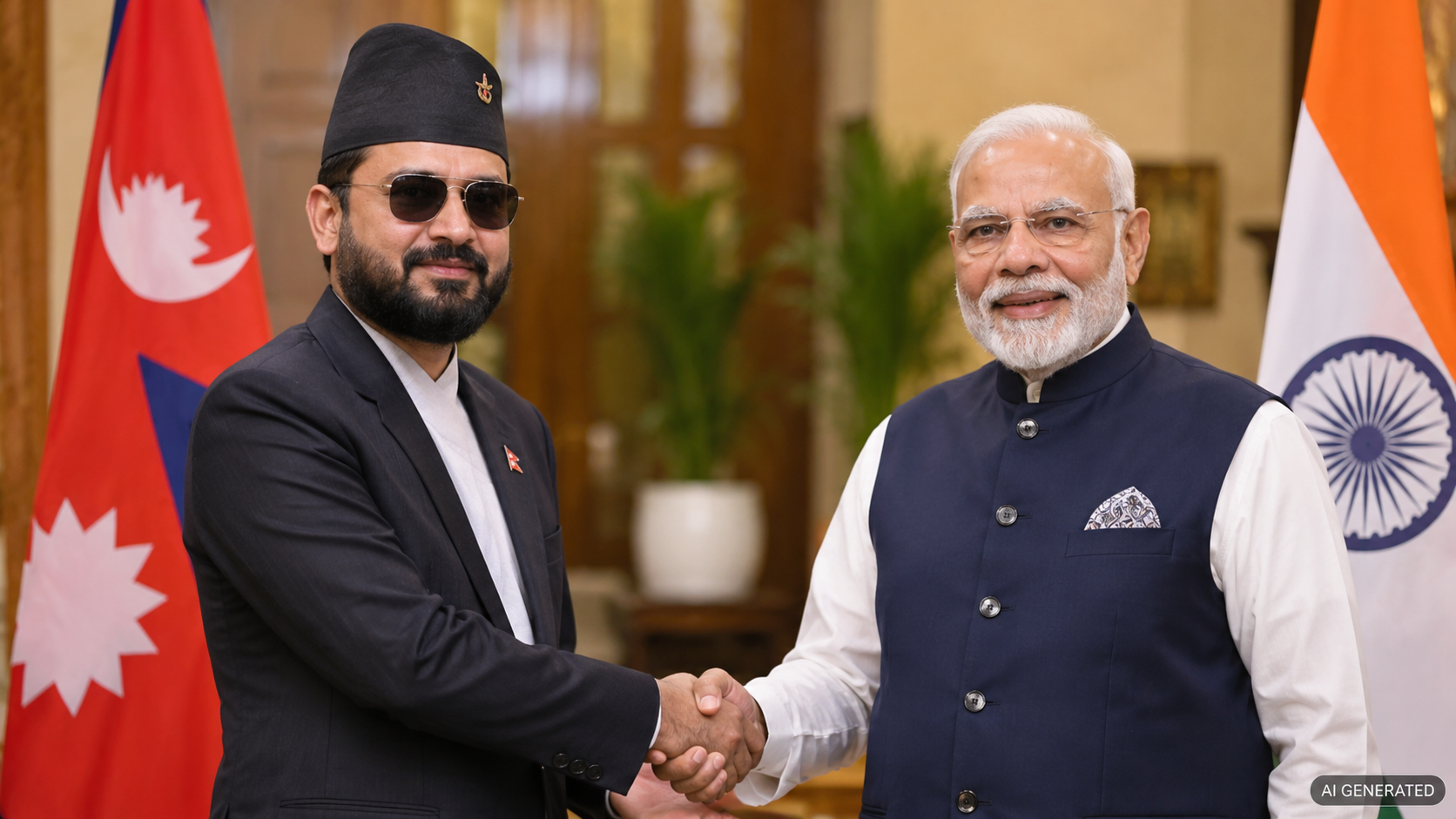
Nepal and India have announced a major development assistance package worth INR 150 billion (NPR 240 billion) following high-level talks between Nepali Prime Minister Balendra Shah and Indian Prime Minister Narendra Modi during Shah’s two-day state visit to India from November 22 to 23. According to the joint press release issued in New Delhi on November 23, India will provide INR 35 billion (NPR 56 billion) in grant assistance for post-disaster reconstruction and new infrastructure projects, alongside an INR 115 billion (NPR 184 billion) rupee-denominated Line of Credit for Nepal’s energy sector. The specific projects and financing arrangements will be finalized through bilateral consultations. Shah, making his first official visit to India since assuming office, received a ceremonial welcome at Rashtrapati Bhavan, paid tribute to Mahatma Gandhi at Rajghat and met Indian President Droupadi Murmu. The two prime ministers subsequently held delegation-level talks covering bilateral relations, regional issues and global developments. Shah thanked India for its humanitarian and technical support following the devastating Rasuwa–Bhotekoshi floods, while Modi reaffirmed India’s support for Nepal’s development priorities. Both leaders adopted a joint vision titled “Viksit Bharat and Samunnat Nepal,” outlining cooperation in economic development, connectivity, energy, water resources, climate resilience, digital services, space technology, innovation and people-to-people relations.
A series of major connectivity and infrastructure announcements emerged from the visit, including the inauguration of the Sarayu–Kamala Express railway service between Ayodhya and Janakpur, intended to strengthen cross-border transportation and religious tourism along the Ramayana Circuit. Both leaders also announced completion of the Field Location Survey for the proposed Raxaul–Kathmandu electrified broad-gauge railway and agreed to cooperate on developing Nepal’s East–West Railway. They virtually laid the foundation stone for a new Integrated Check Post at Banbasa, reviewed progress on similar facilities at Bhairahawa, Sunauli and Dodhara–Chandani, and inaugurated a motorable bridge connecting Dharchula in India with Darchula in Nepal. India additionally announced access to Deendayal Port in Gujarat for Nepal’s transit trade, with access to Paradip Port in Odisha expected after the necessary infrastructure is completed. The countries also agreed to make the existing unidirectional Kathmandu–Bhairahawa–Lucknow B345 aviation route bidirectional, subject to technical consultations. In the petroleum sector, the leaders dedicated the second phase of the Motihari–Amlekhgunj pipeline, virtually laid the foundation stone for a petroleum terminal in Jhapa, and discussed accelerating the Siliguri–Jhapa pipeline and exploring cross-border gas pipeline cooperation. They also directed their foreign secretaries to address outstanding boundary issues while acknowledging progress in the maintenance of border pillars.
Energy cooperation featured prominently in the bilateral discussions, with the two leaders virtually laying the foundation stone for the 669-megawatt Lower Arun Hydroelectric Project and agreeing to accelerate ongoing hydropower projects involving Indian companies in Nepal. They instructed the Pancheshwar Development Authority and Joint Committee on Water Resources to expedite the Detailed Project Report for the Pancheshwar Multipurpose Project and begin implementation, while also advancing the detailed studies of the Saptakoshi and Sunkoshi multipurpose projects. Both sides welcomed progress toward establishing joint ventures for the high-capacity Inaruwa–New Purnea and Dododhara–Bareilly cross-border electricity transmission lines, considered important for expanding regional power connectivity. In education and technology, India agreed to establish an offshore Indian Institute of Technology (IIT) campus in Nepal, while both governments welcomed expanding cooperation in start-ups, digital and financial connectivity. They also announced plans for an Agro-Industrial Park in Chitwan with Indian grant assistance, recognized progress on the India-supported National Police Academy and community development projects, and discussed improving access to banking and telecommunications services for citizens residing across the border.
The visit also resulted in the exchange of eight Memoranda of Understanding (MoUs) covering forensic science, police training, civil service capacity building, traditional medicine, satellite communications, sustainable urban development, healthcare, and livestock and fisheries development. The agreements include academic and research collaboration between India’s National Forensic Sciences University and Nepal Police’s Crime Investigation Department; cooperation between Rashtriya Raksha University and Nepal’s National Police Academy; civil servant training through India’s National Centre for Good Governance and Nepal Administrative Staff College; and collaboration on Ayurveda and other traditional systems of medicine. Additional agreements involve the Indian Space Research Organisation (ISRO) and Nepal’s Ministry of Information and Communication to establish a satellite communication network using the South Asia Satellite, cooperation on sustainable urban development, health and medicine, and livestock and fisheries development. Both governments also committed to expanding cooperation in climate change mitigation, disaster preparedness, emerging technologies and cultural tourism, including possible Buddhist and Shiv-Shakti tourism circuits. At the conclusion of the visit, Prime Minister Shah formally invited Narendra Modi to visit Nepal, and Modi accepted, with dates to be finalized through diplomatic channels. The joint announcements represent an extensive package of development commitments and infrastructure initiatives, although several projects, financing modalities and technical arrangements remain subject to further consultations and implementation decisions.