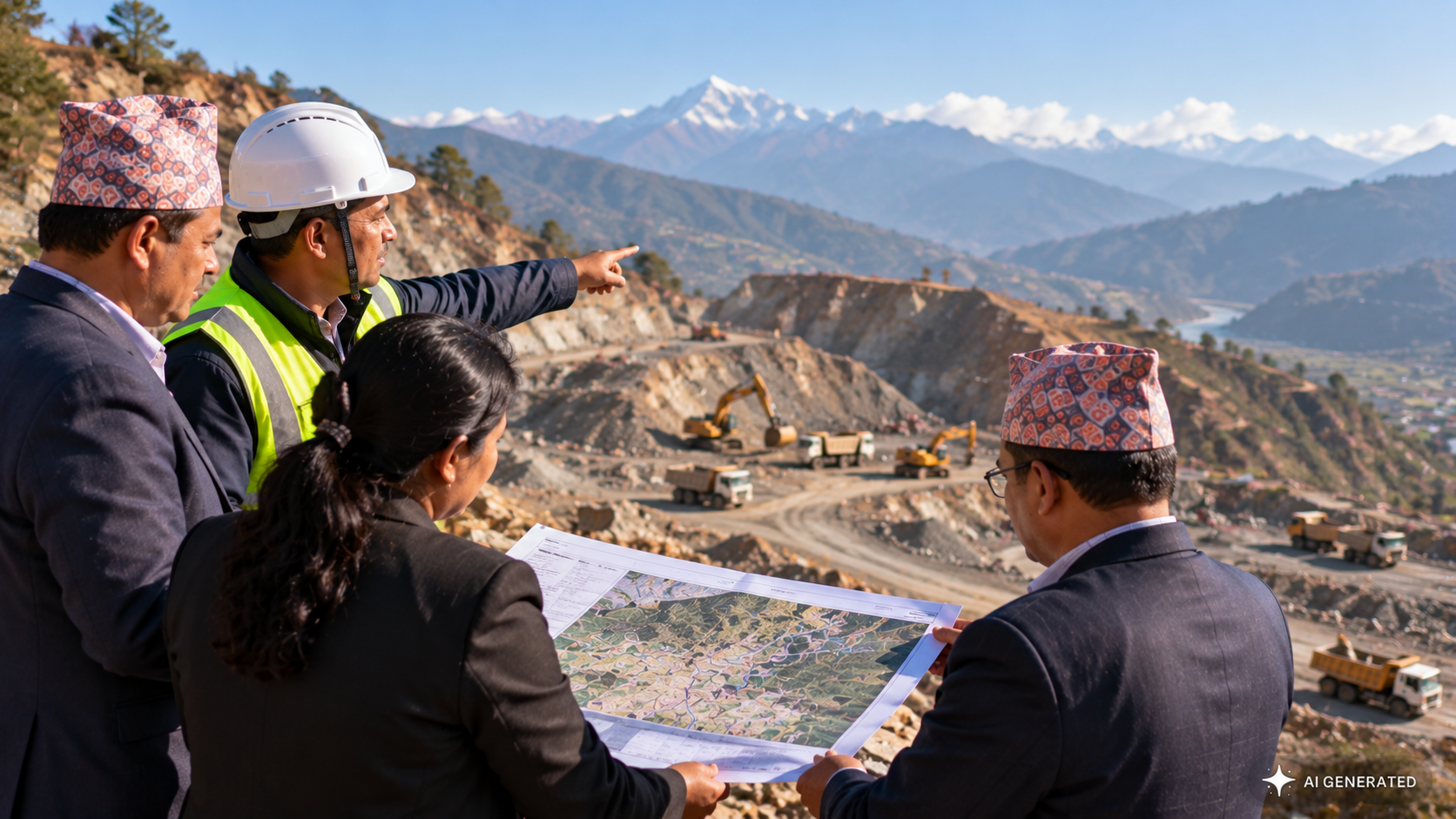
The bill declares all naturally occurring minerals found on or beneath land in Nepal to be government property, while distributing responsibilities across the three levels of government. Provinces would generally handle exploration, the federal government would retain authority over extraction, and local governments would be able to permit ordinary construction minerals such as stone, gravel, sand, soil and slate within their areas, subject to approved environmental studies. The federal government could also designate mineral zones and classify certain resources as strategic or militarily important, imposing restrictions on storage, use, transport or export where necessary.
The proposed law creates separate exploration and extraction licences, with extraction permits lasting 10, 15, 20 or 30 years depending on the scale of mining, and provides for extensions under prescribed conditions. It requires environmental compliance, compensation for damage to private land or crops, annual reporting, site rehabilitation after mining ends and government approval for ownership transfers. The bill also allows authorities to immediately halt mining that violates permit conditions, threatens public health or property, breaches environmental approvals or endangers sensitive infrastructure.
Special provisions reserve radioactive minerals, including uranium and thorium, for the Government of Nepal or a wholly state-owned company, with prior regulatory approval and strict requirements on radiation safety, public health, transport, waste management, insurance and environmental protection. The bill also expands the Department of Mines and Geology’s role in geological surveys, earthquake monitoring, seismic-risk mapping and research, and allows establishment of a national geological and mineral-testing laboratory.
Enforcement would become substantially tougher. Unauthorized exploration could attract fines of up to Rs 500,000, while illegal extraction could result in recovery of the assessed mineral value plus an equal fine, or Rs 2.5 million to Rs 10 million where the value cannot be determined. Illegal activity involving radioactive minerals could carry five to 10 years in prison and fines of Rs 500,000 to Rs 1 million. The bill also sets new licence fees, deposits and mineral-specific royalties, requires an additional 10% of royalty as a local mineral-use fee, and mandates review of royalty rates at least every five years.