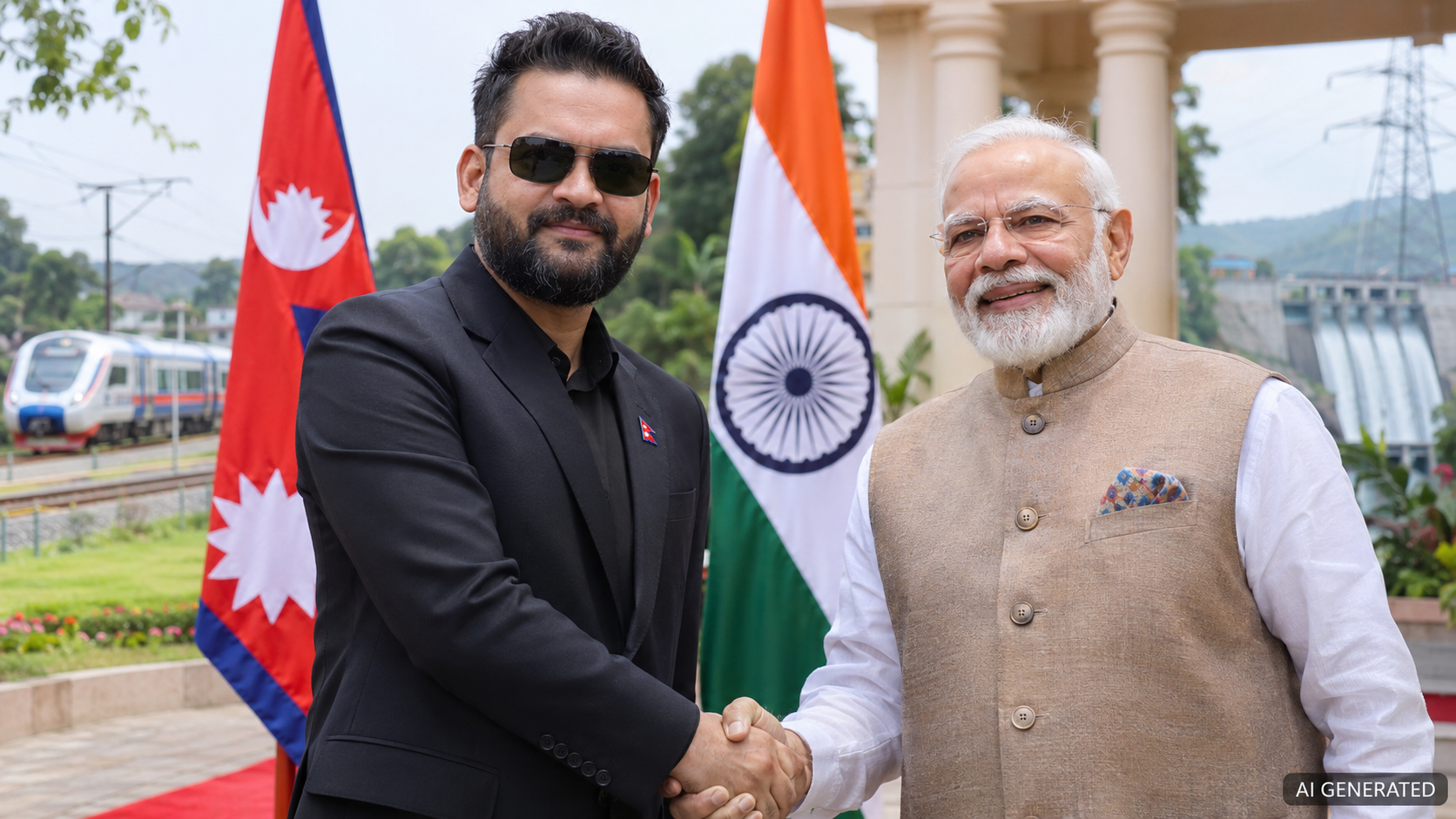
Prime Minister Balendra Shah returned to Nepal on November 23 after completing a two-day state visit to India, during which the two governments announced a NPR 240 billion (INR 150 billion) development assistance package covering disaster reconstruction, infrastructure development and energy projects. Speaking at Tribhuvan International Airport following the Prime Minister’s return, Foreign Minister Shishir Khanal described the visit as a significant step toward strengthening bilateral economic and diplomatic cooperation. According to the ministry’s press note, India committed NPR 56 billion (INR 35 billion) in grant assistance for post-disaster reconstruction and new infrastructure projects, alongside NPR 184 billion (INR 115 billion) in rupee-denominated credit facilities for energy-sector development. Khanal described the package as the largest development assistance commitment of its kind received from India. During the visit, Shah met Indian President Droupadi Murmu and held delegation-level talks with Prime Minister Narendra Modi at Hyderabad House in New Delhi. The two leaders also issued a joint vision document titled “Viksit Bharat–Samunnat Nepal,” outlining a forward-looking partnership covering economic development, physical and digital connectivity, energy, climate resilience, disaster management, sports, agriculture, education, health, start-ups, space technology and innovation. Khanal stated that the document also creates an opportunity to review longstanding bilateral treaties and arrangements, including the 1950 Nepal–India Treaty, where necessary, although no specific treaty amendment was announced.
The visit produced several major announcements concerning trade, transportation and cross-border infrastructure. India agreed to provide Nepal with additional transit access through Deendayal Port in Kandla, Gujarat, and Paradip Port in Odisha, supplementing existing routes through Kolkata and Visakhapatnam. The leaders jointly inaugurated a passenger railway service connecting Janakpur and Ayodhya, intended to strengthen religious tourism and people-to-people connections. They also agreed to make the existing one-way B345 Kathmandu–Bhairahawa–Lucknow air route bidirectional, subject to further technical arrangements. The two prime ministers inaugurated a motorable bridge linking Darchula in Nepal with Dharchula in India and laid the foundation stone for an Integrated Check Post at Banbasa to facilitate customs clearance, cross-border movement and trade. Khanal emphasized that improving transit arrangements and expanding access to international markets had been longstanding priorities for Nepal. On outstanding boundary matters, the two leaders acknowledged progress in joint field inspections and boundary pillar maintenance and instructed their respective foreign secretaries to continue work on unresolved issues.
Energy cooperation emerged as another major outcome, with the two governments agreeing to advance high-capacity cross-border electricity transmission infrastructure between Inaruwa–New Purnea and Dodhara–Bareilly through joint venture arrangements. The leaders also jointly laid the foundation stone for the Lower Arun Hydropower Project, while agreeing to accelerate the finalization of the Detailed Project Report for the long-pending Pancheshwar Multipurpose Project. In petroleum infrastructure, the second phase of the Motihari–Amlekhgunj pipeline was dedicated for operation, alongside an announcement concerning the development of the Siliguri–Jhapa petroleum connection. The discussions also included plans to establish an offshore campus of the Indian Institute of Technology (IIT) in Nepal, which the government expects to support higher education, research, innovation and skilled workforce development. Following the bilateral talks, Modi presented India’s PM Gati Shakti National Master Plan, highlighting the integration of roads, railways, aviation, waterways and ports for infrastructure and logistics development. Finance Minister Dr. Swarnim Wagle also addressed the Nepal–India Business Roundtable, encouraging Indian entrepreneurs and investors to explore commercial opportunities in Nepal.
The two governments additionally exchanged eight Memoranda of Understanding (MoUs) covering forensic science research, police training, civil service capacity building, Ayurveda and traditional medicine, satellite communications, sustainable urban development, healthcare, and livestock and fisheries development. Among the notable agreements was cooperation between the Indian Space Research Organisation (ISRO) and Nepal’s Ministry of Information and Communication to establish a satellite communications network using the South Asia Satellite. Other agreements included research collaboration between India’s National Forensic Sciences University and Nepal Police’s Crime Investigation Department, cooperation between Rashtriya Raksha University and Nepal’s National Police Academy, and training support for Nepali civil servants through India’s National Centre for Good Governance. Foreign Minister Khanal stated that the visit had strengthened the foundation for practical cooperation and opened opportunities for modernizing bilateral arrangements in response to emerging economic and technological priorities. He characterized the visit as a major diplomatic achievement for Nepal, while the announced assistance, infrastructure projects and institutional partnerships will require subsequent implementation arrangements. The press note confirms the financial commitments, agreements and diplomatic understandings but does not establish that the full assistance package has been disbursed or that all announced projects have entered construction.