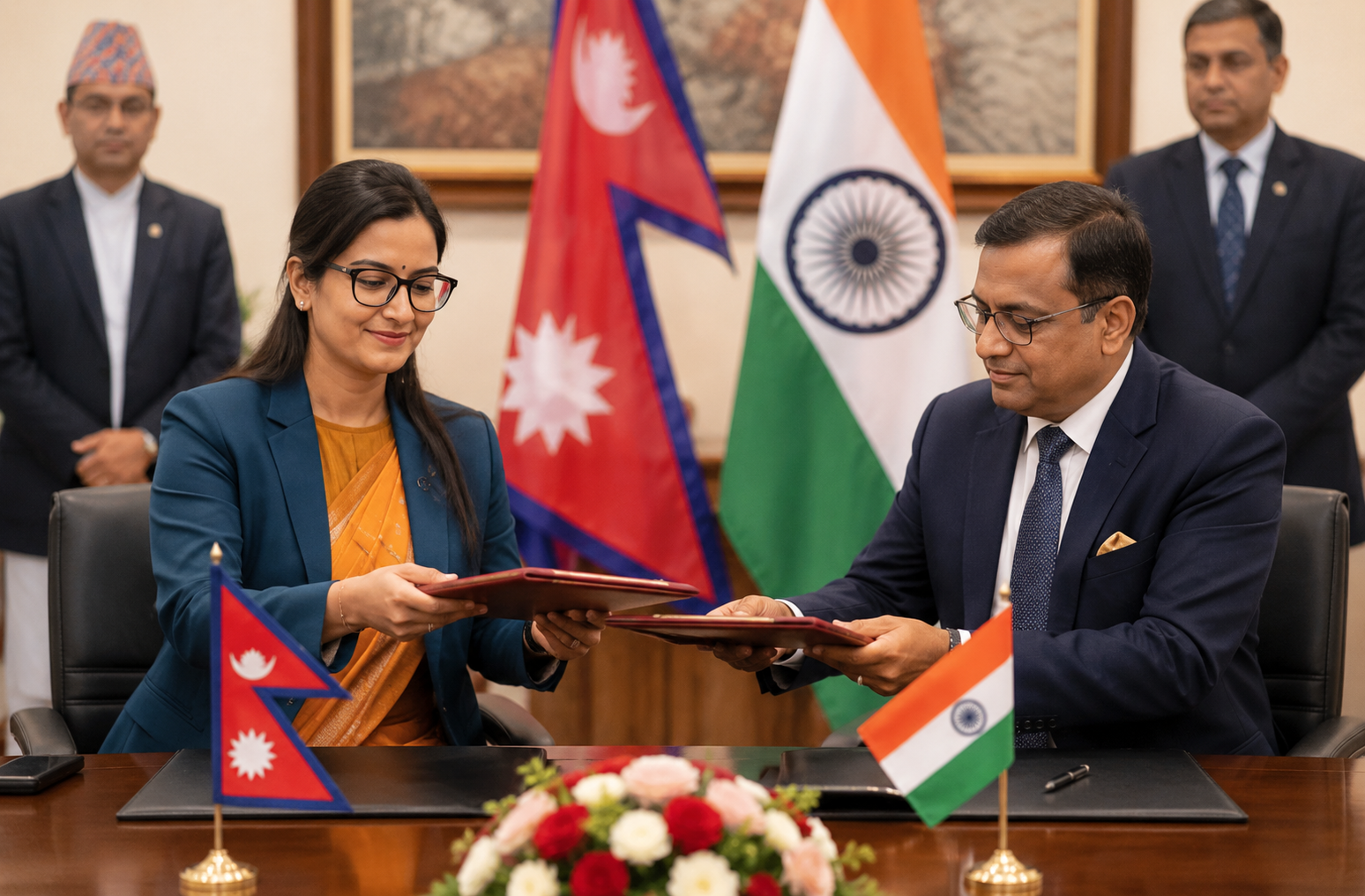
Nepal and India have signed an Agreement on Mutual Legal Assistance in Criminal Matters to enhance cooperation in criminal investigations, prosecutions and judicial proceedings. The agreement was signed in Kathmandu on 17 February 2026 by Binod Kumar Bhattarai, Joint Secretary at Nepal’s Ministry of Law, Justice and Parliamentary Affairs, and Naveen Srivastava, Ambassador of India to Nepal.
The agreement allows both countries to assist each other in collecting evidence, recording statements, serving summons, sharing criminal and judicial records, identifying accused or convicted persons, locating people and objects, carrying out search and seizure, lending exhibits, and making detained or other persons available for testimony or investigation. It also includes cooperation on digital and personal data, video conferencing, bank information, terrorism financing, proceeds of crime, asset freezing, confiscation and joint investigations.
For implementation, Nepal’s Ministry of Law, Justice and Parliamentary Affairs and India’s Ministry of Home Affairs will act as central authorities. Requests must generally be made in writing, while urgent requests must be followed by a written request within 10 days. The agreement also includes safeguards on confidentiality, data protection, safe conduct for witnesses, cost-sharing, and limits on use of shared information.
The pact does not cover extradition, transfer of sentenced persons, transfer of criminal proceedings, or enforcement of criminal judgments except where allowed by domestic law. Assistance may be refused if a request affects sovereignty, security, public order, national interest, domestic law, court orders, double jeopardy protections, political or military offences, or if there are grounds to believe the request is discriminatory.