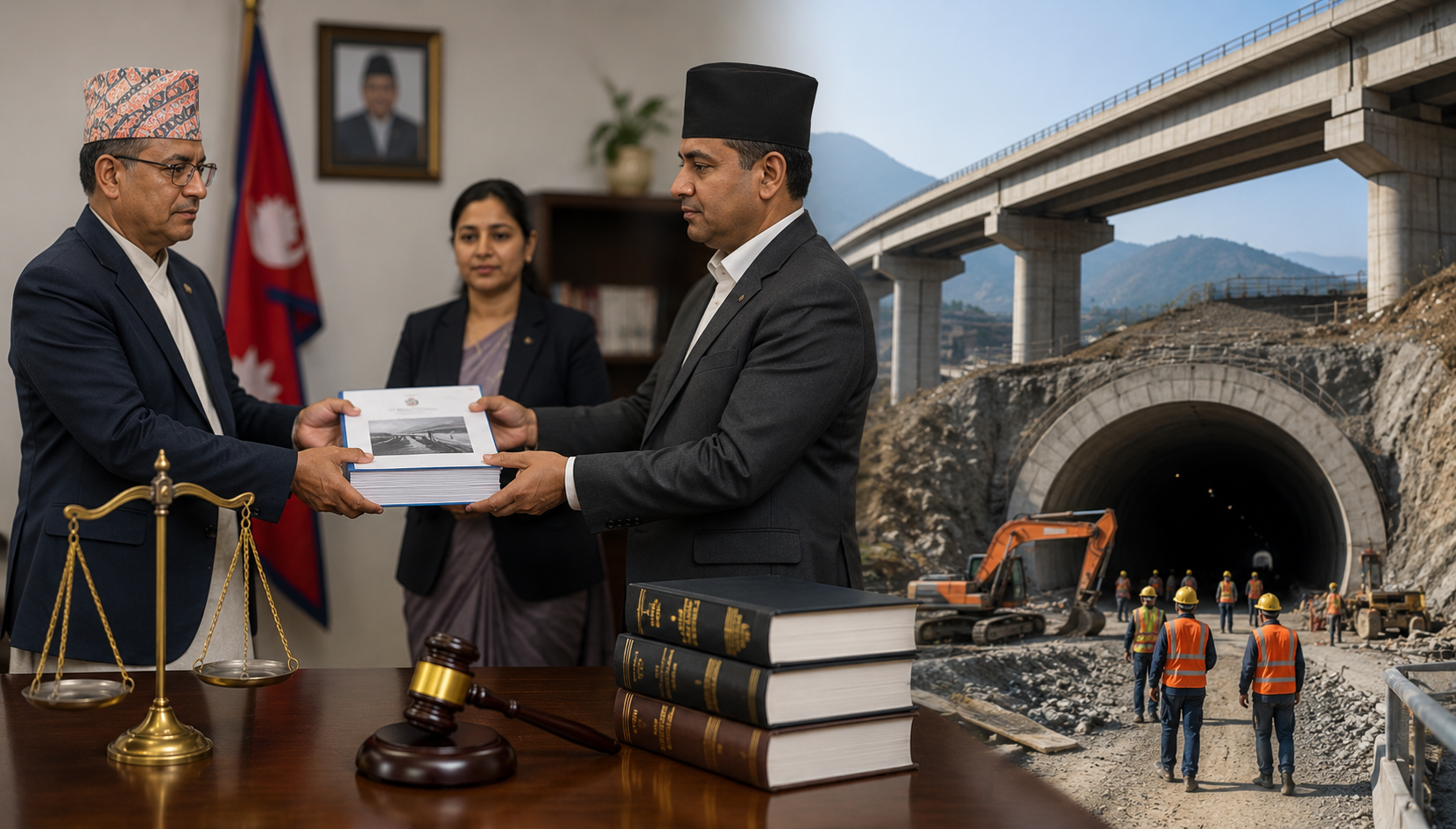
A high-level study committee has submitted a report on reforms needed to resolve court cases related to infrastructure construction and development projects quickly. The committee was formed by a ministerial decision of the Ministry of Law, Justice and Parliamentary Affairs on 2082 Chaitra 25 and submitted its report on 2083 Baisakh 10.
The report says infrastructure projects are being delayed due to legal disputes over land acquisition, compensation, site clearance, environmental approvals, procurement, contract execution, bank guarantees and arbitration. It notes that many parties directly approach courts through writ petitions instead of using legal remedies such as procurement review committees, appeal mechanisms or contract-based dispute resolution. Interim and ex-parte interim orders from courts often stop project work for long periods, increasing both project time and cost.
The study also points to court backlog, long hearings, repeated adjournments, delays in preparing full judgments, naming too many government agencies as defendants, and lack of technical understanding in complex infrastructure disputes as major reasons for delay. The report warns that such delays can make projects financially unviable and deprive the general public of services and benefits expected from public infrastructure.
The report recommends creating Dedicated Fast Track Infrastructure Benches in courts, deciding infrastructure-related cases within 60 days, issuing final decisions within two months in cases where interim orders are granted, limiting unnecessary adjournments and long arguments, and preparing full judgments within 21 working days. It also proposes establishing a separate Infrastructure Tribunal with a judge, finance expert and engineering expert.
The committee further recommends amendments to the Arbitration Act, Public Procurement Act, Judicial Administration Act, Civil Procedure Code and court rules. Other proposed reforms include applying the “work continues” principle, using escrow accounts for disputed amounts, adopting a “no clearance, no tender” policy, forming project-level Dispute Resolution Boards, introducing time-bound arbitration, giving legal basis to a public interest test, allowing re-tendering of long-stalled projects, and improving digital monitoring and accountability.