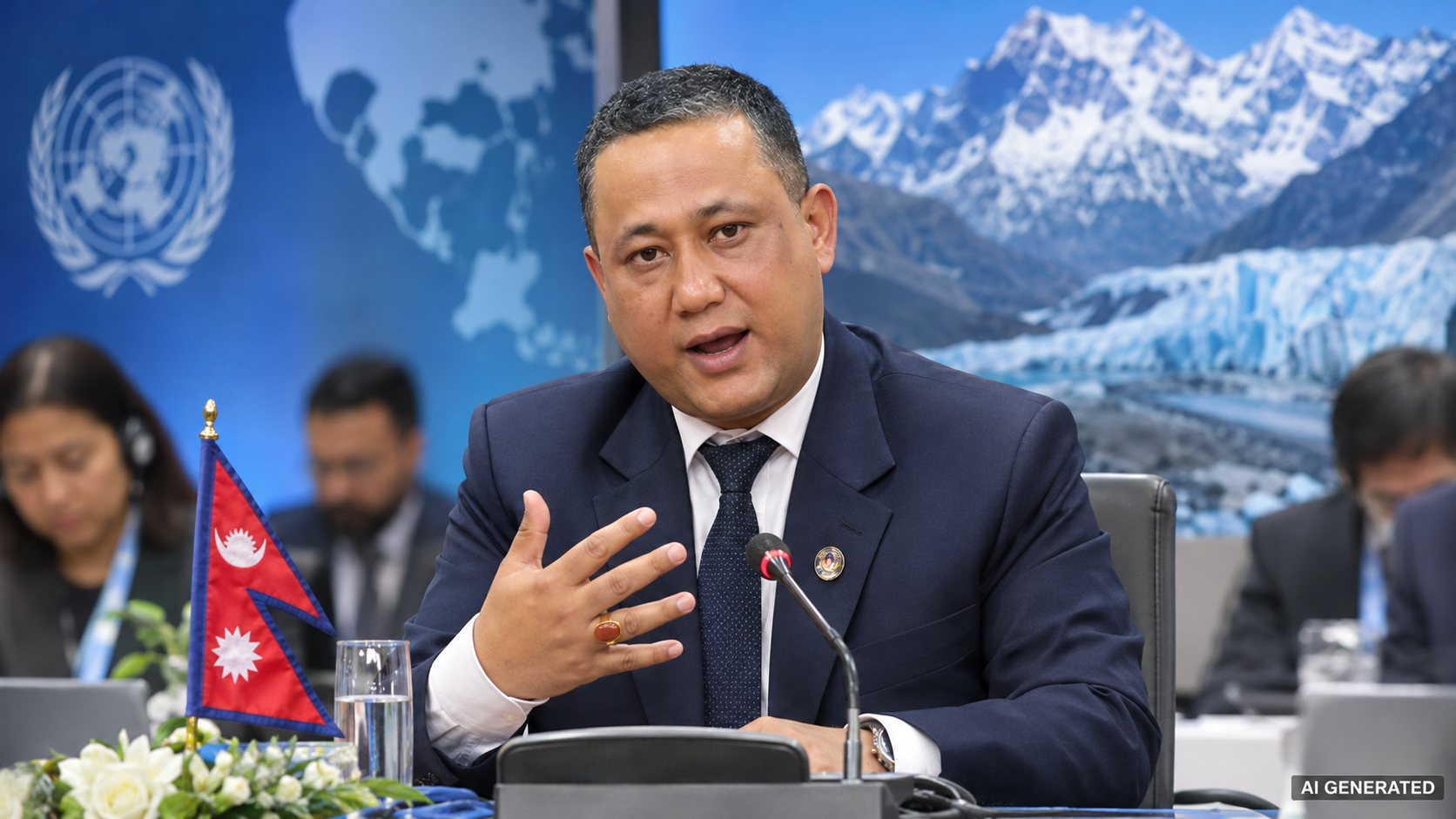
Foreign Minister Shisir Khanal has returned to Nepal after leading the country’s delegation at the 31st Conference of the Parties (COP31) to the United Nations Framework Convention on Climate Change (UNFCCC), held in Antalya, Türkiye, from November 9 to 20, 2026. According to a press note issued by the Ministry of Foreign Affairs on Kartik 28, 2083 BS, Khanal participated in high-level meetings and international climate negotiations from November 9 to 13, emphasizing Nepal’s vulnerability to climate-induced disasters and the urgent need for stronger global action. Addressing the COP31 opening plenary on November 9, he called for a dedicated Work Programme on Mountains and Climate Change, urging international negotiators to recognize the specific vulnerabilities of mountain regions in global climate policies. He also advocated maintaining the 1.5°C global warming limit, incorporating mountain-specific indicators into the Global Goal on Adaptation (GGA) and the New Collective Quantified Goal on Climate Finance (NCQG), and securing international assistance for Nepal’s post-disaster reconstruction. Agriculture, Forest and Environment Minister Gita Chaudhary is scheduled to lead Nepal’s delegation during the conference’s final week.
During the Baku High-Level Dialogue on Adaptation on November 10, Khanal spoke on behalf of the Least Developed Countries (LDCs), highlighting the disproportionate impacts of climate change on countries contributing relatively little to global greenhouse gas emissions. He urged developed nations and international financial institutions to translate climate finance commitments into credible implementation plans, simplify access to funding, and prioritize locally led adaptation initiatives. At the Antalya Leaders’ Summit on November 11, he joined international leaders, including United Nations Secretary-General António Guterres, in discussions on global climate action. Khanal also addressed the High-Level Event on Early Warnings for All, emphasizing the importance of satellite-based monitoring, real-time Himalayan climate data, snow and glacier monitoring, and accessible early warning information in local languages. During a separate high-level programme on advancing the mountain agenda on November 12, jointly organized by Nepal, Bhutan, Kyrgyzstan, Pakistan, and Tajikistan, he called for substantial emissions reductions, grant-based climate finance instead of debt-generating assistance, and rapid financial support for climate-related loss and damage.
Nepal also strengthened its push for regional cooperation, mountain resilience, and disaster preparedness through several thematic events at COP31. In collaboration with Bhutan, Kyrgyzstan, the International Centre for Integrated Mountain Development (ICIMOD), and Zoï Environment Network, Nepal organized a high-level event on strengthening mountain resilience through adaptation finance. Khanal highlighted the human, physical, and economic damage caused by recent devastating floods in Nepal, emphasizing the need for adequate and accessible international financing. At the Nepal Pavilion, he addressed regional cooperation in the Hindu Kush Himalaya, calling for cross-border disaster coordination, technology transfer, scientific knowledge exchange, and stronger partnerships among governments and stakeholders. He also participated in discussions on climate finance access for Small Island Developing States (SIDS), Least Developed Countries, and landlocked developing countries. The Nepal Pavilion, inaugurated on November 9, showcased the country’s climate commitments, biodiversity conservation achievements, and community-based adaptation initiatives while drawing attention to increasing Himalayan risks and the recent Bhotekoshi disaster.
Beyond climate negotiations, Khanal held bilateral and high-level meetings with Ethiopian Foreign Minister Gedion Timothewos, Finnish Minister for Foreign Trade and Development Ville Tavio, and UN Secretary-General António Guterres. He also participated in a collective meeting between LDC representatives and the UN Secretary-General and interacted with Nepali community representatives in Türkiye, reaffirming the government’s commitment to improved digital consular services, migrant worker protection, and safer overseas employment. According to the ministry, the Foreign Minister’s COP31 engagements included one opening plenary address, participation in the Antalya Leaders’ Summit, six high-level and thematic addresses, three bilateral or high-level meetings, the Nepal Pavilion inauguration, and other diplomatic and media interactions. The ministry stated that Nepal’s participation helped raise international awareness of the climate challenges confronting Himalayan countries, particularly concerning adaptation finance, disaster recovery, glacier monitoring, and climate justice. The press note outlines Nepal’s diplomatic demands and participation but does not announce any confirmed new climate funding commitments or finalized international agreements. Nepal’s efforts at COP31 underline its growing emphasis on integrating mountain-specific climate vulnerabilities into global climate negotiations and strengthening international cooperation for a more resilient future.