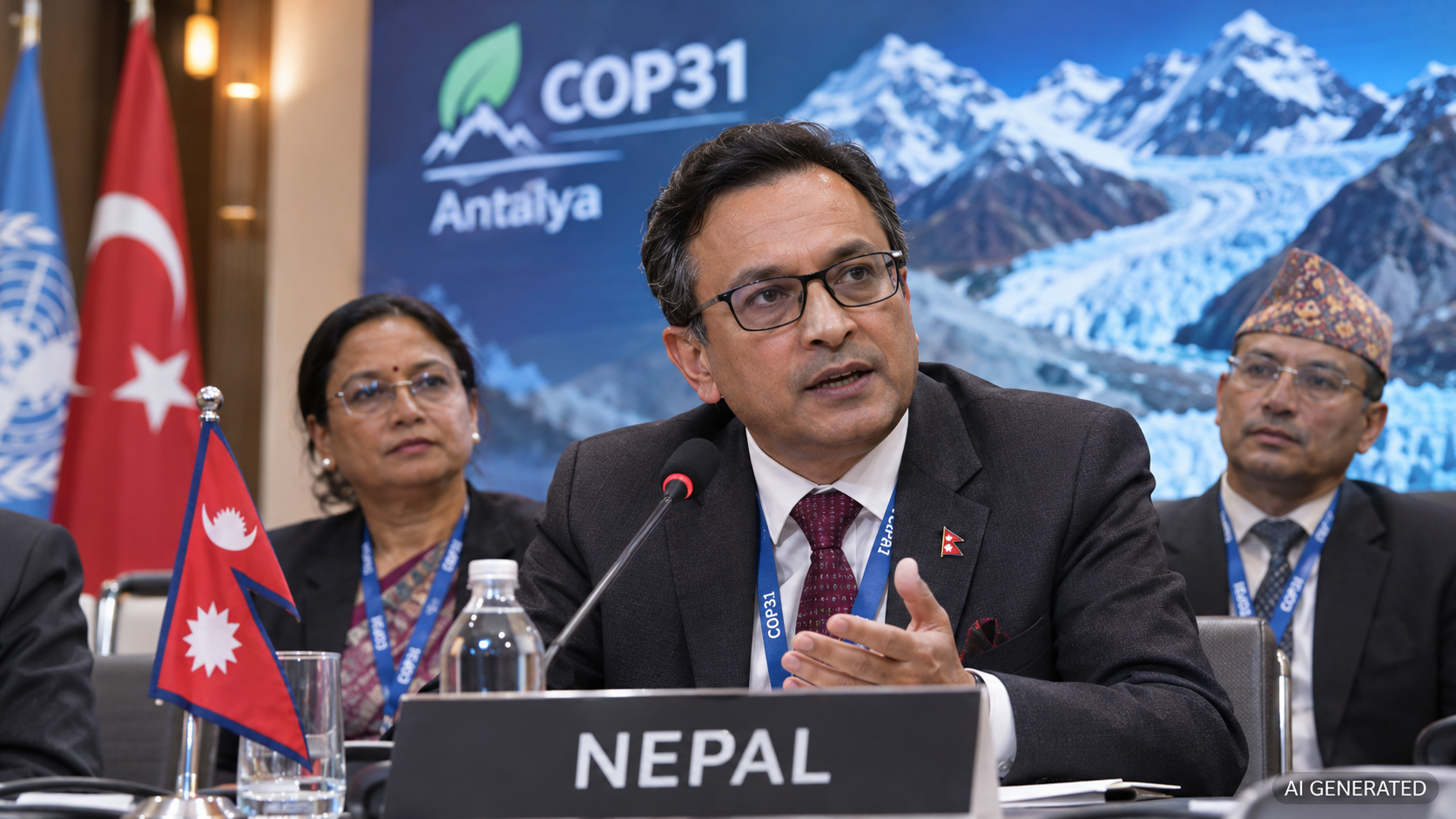
Nepal has issued an urgent appeal for climate justice, stronger international financing and dedicated global action to protect mountain ecosystems during the 31st Conference of the Parties (COP31) in Antalya, Türkiye. Addressing international delegates, Nepal’s representative highlighted the devastating consequences of a catastrophic mountain collapse on August 26, 2026, describing the disaster as a “Himalayan Tsunami” that claimed more than 1,400 lives, left over 5,000 people missing and destroyed critical infrastructure within minutes. According to the statement, the estimated cost of reconstruction amounts to approximately 10 percent of Nepal’s entire economy, placing an enormous financial burden on the country. The address also noted that Nepal experienced three major disasters between August and October 2026, underscoring the growing vulnerability of Himalayan communities to climate-related hazards. The speaker stated that scientific evidence confirmed climate change had contributed to the August disaster, emphasizing the urgent need for stronger global climate action.
Despite contributing only a negligible share of global greenhouse gas emissions, Nepal emphasized that it faces disproportionate consequences from rising temperatures and the rapid melting of Himalayan glaciers. The statement highlighted the country’s environmental commitments, noting that approximately half of Nepal’s land is covered by community-conserved forests, its energy supply relies on hydropower, and electric vehicles account for more than 70 percent of newly purchased consumer vehicles, according to the figures presented in the address. Nepal warned that the Himalayan region supports the lives and livelihoods of a substantial proportion of humanity through its mountain ecosystems and water resources. The representative also expressed concern that mountains, covering approximately 27 percent of global geography and supporting around 15 percent of the world’s population, have not received sufficient priority in international climate negotiations. Nepal aligned itself with the positions of the Group of 77 and China, Least Developed Countries (LDCs), Landlocked Developing Countries (LLDCs) and the Mountain Group, reaffirming its demand for equitable international climate governance.
A central demand of Nepal’s COP31 address was the formal recognition of mountains and climate change as a dedicated agenda item under international climate negotiations. Nepal, together with Bhutan and Kyrgyzstan, formally requested the inclusion of mountain-related climate challenges in the COP31 agenda. Although the speaker acknowledged constructive engagement by the conference presidencies and participating countries, Nepal expressed dissatisfaction that progress remained below its expectations. The country presented three key demands: maintaining the urgency of limiting global warming to 1.5°C for mountain regions; establishing a dedicated work programme on mountains and climate change; and integrating mountain-specific indicators into the Global Goal on Adaptation (GGA) and the New Collective Quantified Goal on Climate Finance (NCQG). These proposals aim to ensure that mountain communities receive greater recognition in climate adaptation frameworks and international financing mechanisms, reflecting their particular exposure to glacier loss, extreme weather and environmental degradation.
Concluding the address, Nepal called on the international community to translate expressions of sympathy into institutional commitments, financial support and measurable climate action. The representative emphasized that international solidarity following the catastrophic Himalayan disaster must be followed by meaningful reforms in global climate negotiations and financing arrangements. Nepal reaffirmed its willingness to cooperate with all countries and international partners in developing effective responses to mountain-related climate challenges. The address underscored that protecting Himalayan ecosystems is not only a national concern but also a global responsibility, requiring stronger cooperation among developed and developing countries. The statement presents Nepal’s demands and reported disaster figures but does not announce that COP31 has formally adopted the proposed mountain work programme, approved mountain-specific financing arrangements or committed new reconstruction funding. Nepal’s central message was a call to move beyond diplomatic assurances toward concrete international action: “This is the time to put sympathy into the system. Promises into Action.”