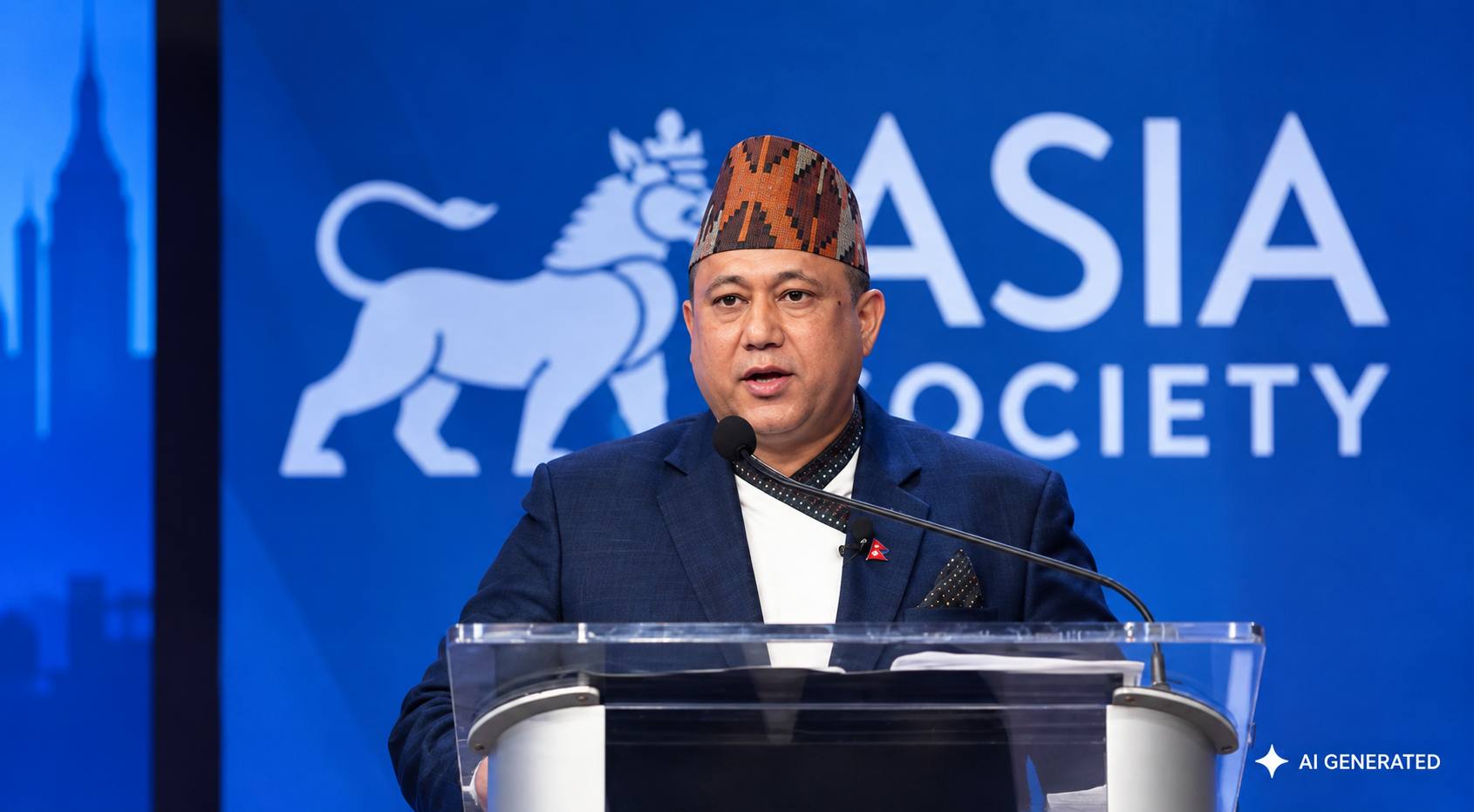
New York, September 25: Foreign Minister Shisir Khanal has said Nepal aims to transform its position between India and China into an economic and strategic advantage as Asia assumes an increasingly prominent role in the global economy. Addressing the Asia Society on “Steering Nepal’s Future in Asia’s Rising Century,” Khanal said Nepal should no longer ask how it can survive between two major powers, but instead focus on how it can create value between them and beyond.
Khanal outlined what he described as Nepal’s doctrine of “developmental autonomy,” under which foreign policy would be used to expand the country’s productive capacity, economic opportunities and room for manoeuvre without choosing sides. Southward, he said Nepal could leverage its open border with India, hydropower potential and Special Economic Zones to strengthen manufacturing and clean-energy trade. Nepal aims to scale up towards 28,000 megawatts of hydropower by 2035, with electricity exports to India and Bangladesh supporting regional industrial decarbonisation.
Northward, Khanal said Nepal seeks a multidimensional Trans-Himalayan connectivity network with China involving roads, tunnels, dry ports, aviation, digital links and cross-border rail. He stressed that cooperation should also include glacial monitoring, disaster early-warning systems, hydrological information, climate adaptation and resilient infrastructure. Khanal said Nepal does not view its northern and southern economic corridors as competing directions, but as an opportunity to become a land-linked gateway to two of the world’s largest markets.
Beyond its immediate neighbours, Khanal said Nepal intends to deepen partnerships with the United States, Europe, Japan, ASEAN and Gulf countries while using clean electricity, digital services and its global diaspora to support economic transformation. Referring to the recent Bhote Koshi disaster, he also described climate change as an existential strategic priority requiring stronger ecological cooperation and predictable grant-based climate finance. Khanal said Nepal’s long-term ambition is to serve not only as an economic bridge but also as a strategic bridge while preserving sovereign autonomy and supporting international law, sovereign equality and multilateral cooperation.