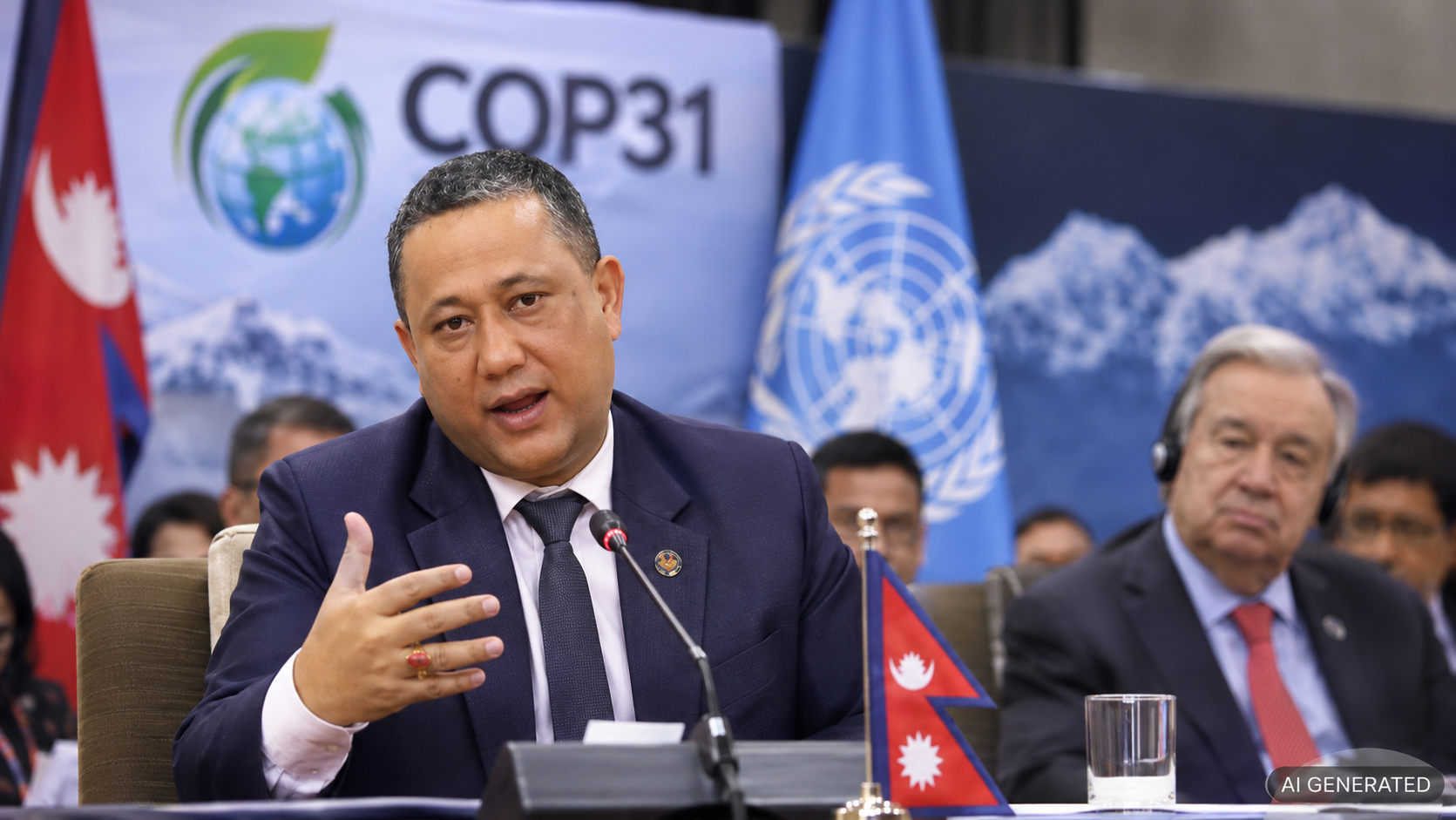
Nepal’s Minister for Foreign Affairs, Shisir Khanal, issued an urgent appeal for stronger global disaster preparedness and climate justice during the high-level event “Early Warnings for All: Delivering on Our Promise to Protect Everyone” held on November 11, 2026, on the sidelines of COP31 in Antalya, Türkiye. Addressing United Nations Secretary-General António Guterres and international representatives, Khanal revealed that the catastrophic August 26, 2026, Himalayan disaster, described as a “Himalayan Tsunami,” had reportedly claimed more than 1,450 lives, with over 5,000 people still unaccounted for. He warned that the death toll could exceed 6,000, although this remains a projection rather than a confirmed casualty figure. The disaster, triggered by an abrupt high-altitude glacial and rock collapse, unleashed massive sediment-laden floodwaters that destroyed highways, settlements, healthcare facilities and hydropower infrastructure within minutes. According to preliminary assessments cited by the minister, reconstruction could require approximately $5 billion, equivalent to around 10 percent of Nepal’s economy, underscoring the enormous financial burden facing the country.
Highlighting the rapidly escalating environmental threats across the Himalayas, Khanal warned that the mountain region could lose up to 80 percent of its glaciers during this century, while stating that its fragile cryosphere had already lost approximately one-third of its ice over the past three decades. He emphasized that the Himalayas function as a critical water source supporting nearly two billion people living downstream, making their protection a matter of international concern. Referring to the August disaster, the foreign minister acknowledged that Nepal’s existing early warning system had transmitted millions of SMS alerts, and downstream communities had received localized warnings. However, he stressed that these measures were insufficient to prevent the massive human and infrastructural losses. Khanal argued that conventional disaster forecasting models fail to adequately anticipate the complex, cascading hazards associated with high-altitude glacial collapses, rockfalls and sudden flooding. He also welcomed the launch of the 2026 Global Status Report on Multi-Hazard Early Warning Systems and recognized Nepal’s participation as one of the 30 initial pilot countries under the United Nations’ Early Warnings for All initiative.
To strengthen disaster preparedness, Foreign Minister Khanal proposed four priority actions aimed at delivering effective early warning protection to vulnerable mountain communities. First, he called for modernizing forecasting systems through real-time telemetry, satellite remote sensing and specialized cryosphere monitoring to address critical observation gaps in mountainous terrain. Second, he emphasized a “last mile first” approach, ensuring that early warnings reach isolated communities within minutes through accessible, local-language alerts supported by institutionalized anticipatory action and community evacuation plans. Third, he urged countries to establish stronger transboundary hydrological data-sharing mechanisms under Nepal’s “Sagarmatha to the Sea” framework, advocating the exchange of river-basin information across international borders without political interference. Finally, Khanal demanded predictable, dedicated and grant-based climate financing, alongside technology transfer, to help vulnerable countries develop sustainable early warning infrastructure without increasing their debt burdens.
The foreign minister stressed that the global commitment to achieving universal early warning coverage by 2027 must translate into long-term institutional capacity and sustained financial assistance rather than ending with the target year. He argued that developing countries facing severe climate threats should not be forced to rely on debt to finance essential disaster prevention and protection systems. Describing climate mitigation and adaptation as matters of climate justice, Khanal urged international partners to accelerate cooperation, improve access to advanced monitoring technologies and provide financial support proportionate to the risks faced by vulnerable nations. He reiterated that effective early warning systems must be capable of protecting communities before disasters occur, rather than merely issuing alerts that cannot be acted upon. The address presented Nepal’s reported disaster losses, preliminary reconstruction estimates and policy demands, but did not announce any newly approved $5 billion funding package or confirmed international financing commitment. Concluding his remarks, Khanal urged world leaders to match the urgency of climate disasters with decisive collective action, declaring: “Early warnings must not end as unheeded alarms. Let us match the speed of climate disasters with the speed of our shared resolve.”