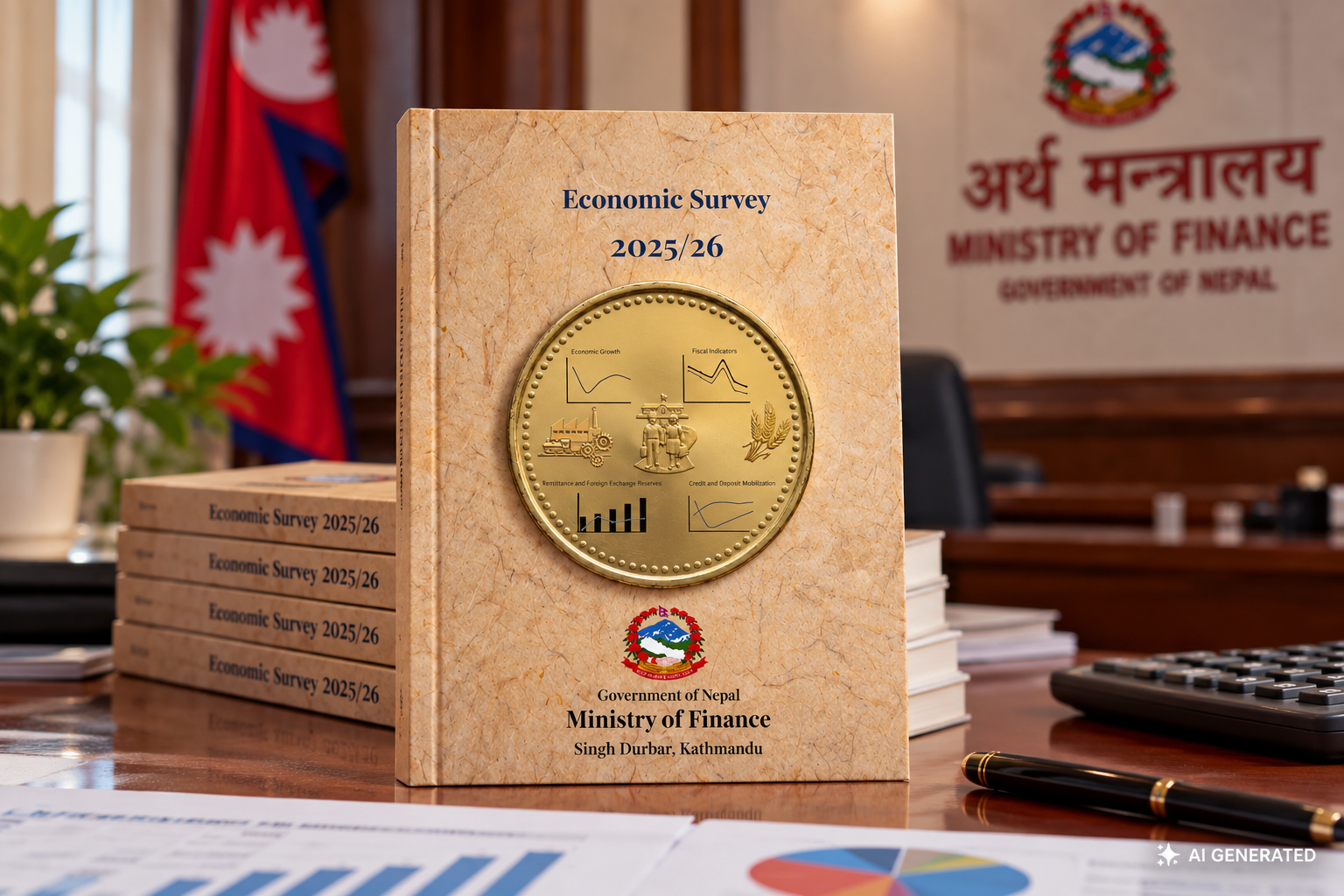
Nepal’s economy is estimated to grow by 3.85 percent in FY 2025/26, down from 4.43 percent in the previous fiscal year, according to the Ministry of Finance’s Economic Survey 2025/26. Agriculture is projected to grow only 1.58 percent, while the non-agricultural sector is expected to expand by 4.54 percent. Services remain the largest part of the economy, accounting for 61.81 percent of GDP, while agriculture’s share has fallen to 24 percent. The survey attributes weaker growth partly to lower paddy production, while electricity, finance, trade and information technology provided stronger support.
The external sector emerged as one of the economy’s strongest areas. Remittance inflows jumped 37.7 percent to Rs. 1,449.70 billion by mid-March 2026, helping produce a Rs. 658 billion balance-of-payments surplus and a Rs. 552.85 billion current-account surplus. Foreign exchange reserves climbed to a record Rs. 3,413.77 billion, sufficient to cover 18.5 months of merchandise and services imports. Meanwhile, average consumer inflation remained relatively low at 2.13 percent, compared with 4.72 percent during the same period a year earlier.
Fiscal pressures, however, continued to build. Outstanding public debt reached Rs. 2,878.30 billion, equivalent to 43.6 percent of GDP by mid-March 2026, with external debt accounting for 53.2 percent of the total. Federal expenditure rose by 10.4 percent while revenue increased by only 3.2 percent, and the government’s overall fiscal deficit widened to Rs. 58.01 billion. Despite abundant banking liquidity, private-sector credit growth remained sluggish, while the average non-performing loan ratio of banks and financial institutions rose to 5.42 percent.
The survey also highlights gains in infrastructure and social indicators. Electricity access reached 99.1 percent of the population, installed generation capacity climbed to 4,105 MW, and Nepal exported 2,918 GWh of electricity to India during the fiscal year. Tourist arrivals reached 1.162 million in 2025, while the absolute poverty rate fell to 20.27 percent. Digital payments also expanded rapidly, with QR-based transactions exceeding Rs. 125 billion by mid-March 2026.