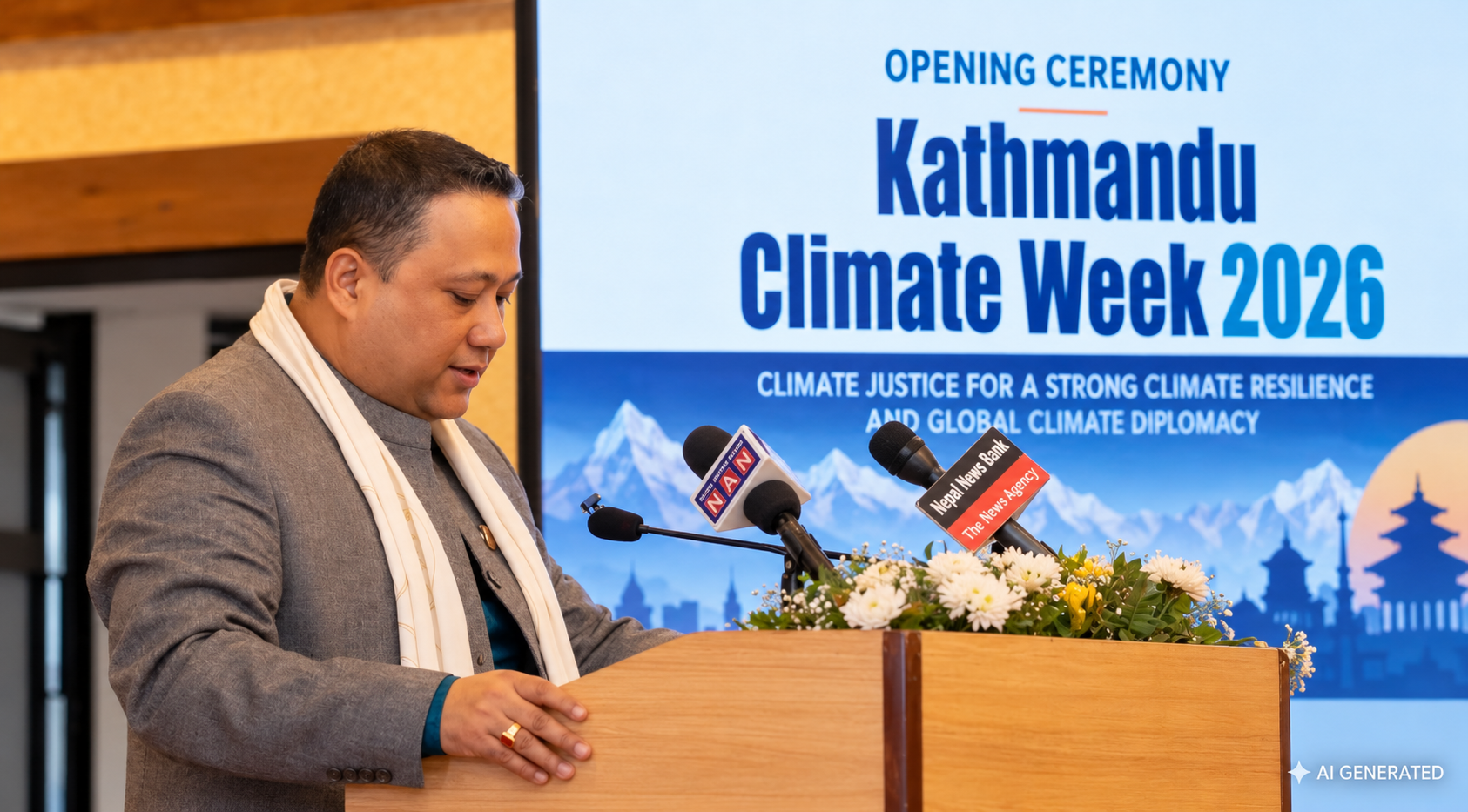
Speaking at the inaugural Kathmandu Climate Week 2026, Foreign Minister Shisir Khanal said climate change has become a direct threat to Nepal’s agriculture, infrastructure, water security, public health, energy transition, fiscal stability and foreign policy. Referring to Nepal’s recent engagements at the 81st UN General Assembly, he said the country had pushed the message that protecting the Himalaya—the “Third Pole”—is essential not only for mountain communities but for global ecological security, including nearly two billion people dependent on downstream water systems.
Khanal linked that diplomatic agenda to the August 26 disaster, describing the event as a “Himalayan Tsunami” caused by a sudden high-altitude glacial and rock collapse that sent a massive sediment-laden flood through mountain valleys. He said the disaster destroyed lives, highways, bridges, hydropower infrastructure and livelihoods, while forcing Nepal to divert scarce development resources toward reconstruction. With Nepal contributing less than 0.1 percent of global greenhouse-gas emissions, he argued that climate justice requires new, predictable, accessible and grant-based finance, alongside adaptation support, technology transfer and capacity-building.
The minister said Nepal has formally approached the Fund for Responding to Loss and Damage following the catastrophe and warned that the mechanism must not become burdened by excessive administrative procedures. He called for the fund to be fully capitalized with new public grants capable of providing rapid liquidity after disasters. At home, he outlined four priorities: climate-resilient infrastructure, faster conversion of scientific data into real-time early-warning systems, stronger institutional capacity to manage climate finance, and greater regional sharing of hydrological and meteorological data across transboundary river systems.
Khanal also announced that the Ministry of Foreign Affairs has established a dedicated Climate Diplomacy Section to connect Nepal’s domestic climate experience with international negotiations. He said Nepal’s voice ahead of COP31 and the Midterm Review of the Doha Programme of Action should be grounded in community experience, scientific evidence and practical solutions, with diplomacy serving as a bridge between local realities and international finance, technology and partnerships.