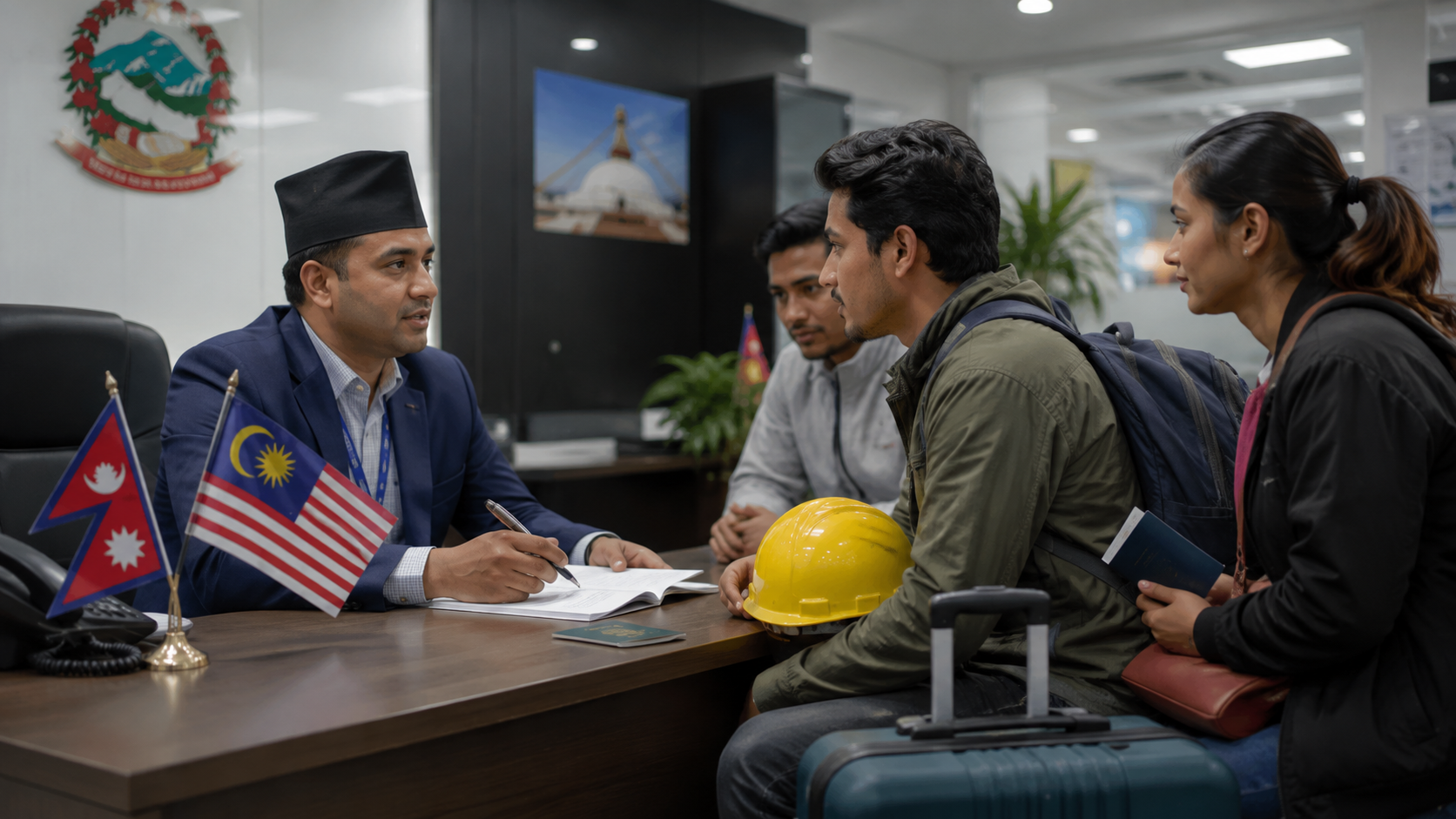
The Ministry of Foreign Affairs has issued the Standard Operating Guidelines for the Embassy of Nepal in Malaysia, dated June 2026, with a focus on ensuring effective and efficient services for Nepali migrant workers. The document notes that Malaysia remains a major destination for Nepali workers, with 370,127 Nepali migrant workers recorded in the country as of December 31, 2024, mainly in manufacturing and service sectors. The guidelines are intended to improve coordination, consistency, accountability and responsiveness at the embassy while providing officials with a practical reference for handling migrant-worker cases.
The guidelines establish detailed procedures covering passport and travel documents, visa services, attestation of job-demand letters, employer inspections, worker complaints, repatriation, compensation, social security and access to information. Employers seeking to recruit Nepali workers must undergo document verification and assessment of wages, accommodation, workplace safety, insurance and legal compliance. The embassy may recommend the blacklisting of recruitment agencies, sponsors, employers or agents involved in fraudulent recruitment, forced labour, trafficking, repeated contract violations, intimidation, physical or sexual abuse, or other serious misconduct. Worker complaints received through visits, telephone, email, social media, hotlines or other channels are required to be registered within 24 hours, with serious cases prioritized for protection, medical assistance, police reporting and legal action.
The document also creates standardized procedures for bringing distressed workers back to Nepal, including cases involving company closure, unpaid wages, workplace abuse, illness, disability, detention, natural disasters, war or workers stranded in Malaysia. Special procedures are provided for vulnerable workers and those requiring medical care, as well as for the repatriation or local burial of deceased Nepalis. Employers are generally expected to settle outstanding salaries, benefits and return-related expenses, while the embassy may coordinate with government agencies, welfare funds, diaspora groups and humanitarian organizations where additional assistance is required. Separate provisions cover workplace injury and death compensation, legal representation and the transfer of compensation to workers or their legal heirs in Nepal.
The guidelines further call for stronger access to information through an embassy hotline, outreach programmes, social-media broadcasts and awareness materials, alongside coordination on Malaysia’s SOCSO social-security system. The document was prepared by the Ministry of Foreign Affairs with input from the Ministry of Youth, Labour and Employment, Department of Foreign Employment, the Embassy of Nepal in Malaysia and the International Labour Organization, with technical assistance under the Migrant Rights and Decent Work project. It also notes that the 2018 Nepal-Malaysia MoU on recruitment, employment and repatriation expired in October 2023, and that a draft for its renewal has been exchanged but had not yet been finalized at the time of the guidelines.