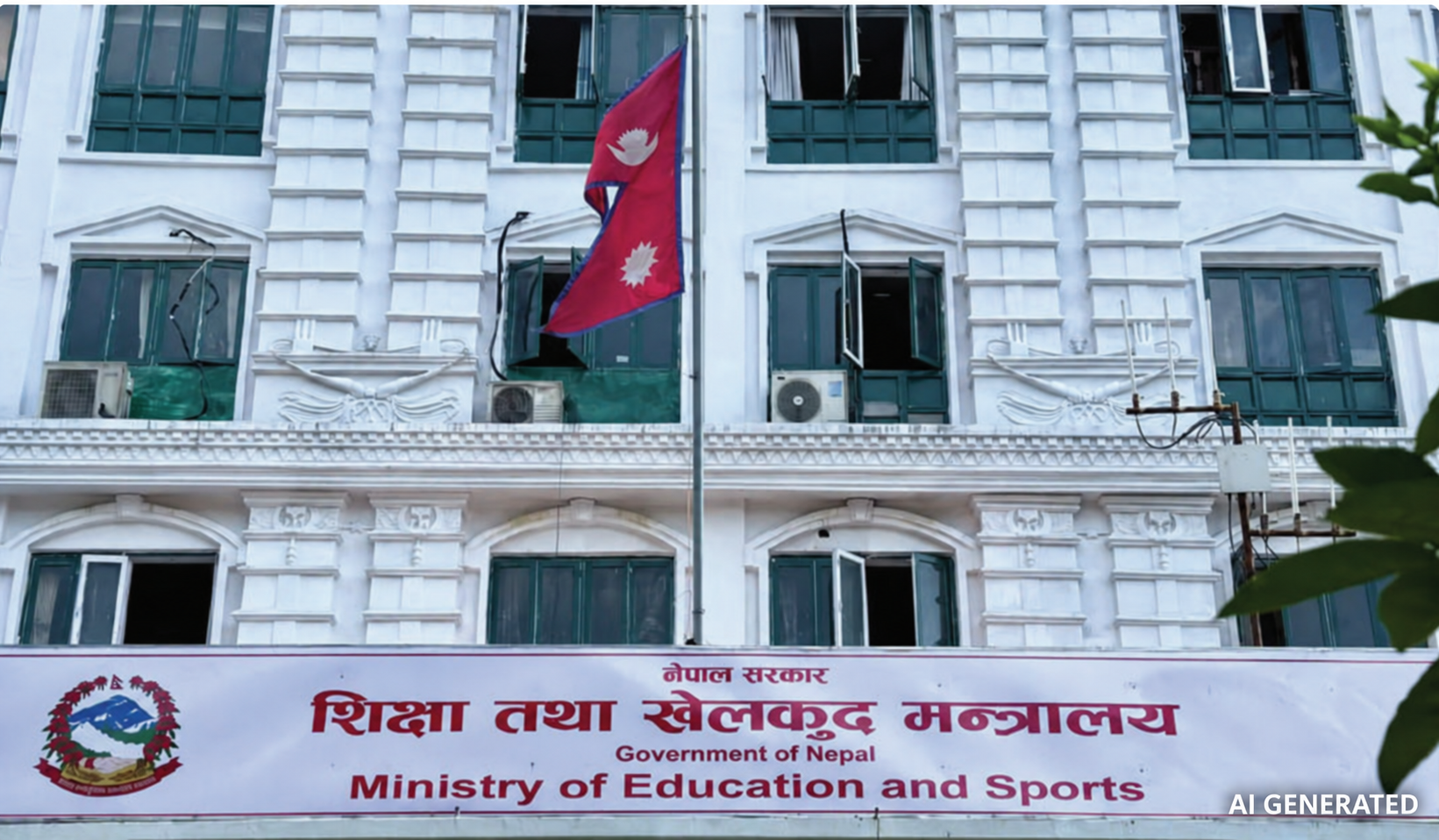
The Government of Nepal has published the Annual Progress Report for Fiscal Year 2025/26 (2082/83 BS), presenting a comprehensive assessment of achievements, financial performance and challenges across the country’s education and sports sectors. Prepared by the Ministry of Education and Sports, the 70-page report states that the sector’s revised annual budget reached approximately Rs 224.60 billion, with 66.87 percent allocated to local governments, 2.19 percent to provincial governments and 30.93 percent retained at the federal level. The federal allocation amounted to approximately Rs 67.37 billion, of which 85.16 percent was spent, according to the report’s detailed expenditure table. While recurrent expenditure reached 88.32 percent, capital expenditure stood at only 54.12 percent, reflecting significant challenges in infrastructure development and project implementation. The report also identifies uneven performance among government agencies and programmes, with the National Sports Council recording just 17.76 percent overall budget utilization, highlighting weaknesses in financial execution despite continued investment in education and sports development.
The report highlights improvements in educational access and examination performance, although significant challenges remain in keeping students enrolled through higher grades. During the 2025/26 reporting period, Nepal recorded 35,951 schools and approximately 7.04 million students enrolled in Grades 1–12, while the net enrolment rate at the basic level reached 97.7 percent. The Secondary Education Examination (SEE) recorded a 65.98 percent graded result among regular candidates, up from 61.81 percent in the previous year, with 284,160 students graded out of 430,667 regular examinees. Similarly, the Grade 12 examination saw 69.75 percent of regular candidates achieve grades in all subjects, compared with 61.17 percent previously. However, the report’s summary indicates that student retention declined to 39.3 percent by Grade 12, demonstrating the continuing difficulty of ensuring secondary education completion. The report also identifies disparities in teacher distribution, educational access and learning outcomes, particularly in mathematics and other core subjects.
Higher education, technical training and digital learning also recorded notable developments. The report states that higher education enrolment increased, with its summary placing the student population at approximately 749,392, while 115,088 No Objection Certificates (NOCs) were issued for overseas study during the fiscal year. The number of higher education institutions receiving Quality Assurance and Accreditation (QAA) certification increased from 114 to 132, reflecting progress in institutional quality assurance. The University Grants Commission reported providing grants to 583 community campuses, while the Council for Technical Education and Vocational Training (CTEVT) expanded career guidance, industry-linked training and skills development initiatives. The ministry also reported the expansion of digital learning resources, teacher training and educational technology platforms. In school infrastructure, 7,677 schools had been reconstructed following the 2015 earthquake, while additional reconstruction projects continued in areas affected by subsequent earthquakes. Government-supported school meal programmes benefited approximately 2.7–2.8 million children, alongside continued scholarship assistance, free textbook distribution and inclusive education initiatives.
Despite these achievements, the ministry acknowledged persistent problems involving low capital expenditure, delays in construction projects, incomplete programme milestones, weak reporting mechanisms and difficulties coordinating activities across federal, provincial and local governments. The report notes that major sports infrastructure projects, including the Mulpani Cricket Academy and Girija Prasad Koirala Cricket Stadium, experienced delays due to budget restrictions and difficulties securing approval for multiyear contracts. In the sports sector, the government reported distributing Rs 108.35 million in cash rewards to 104 athletes and officials for international achievements, while supporting training, competitions and talent development. The ministry emphasized the need to strengthen financial discipline, improve monitoring systems, accelerate infrastructure delivery and shift education reform priorities toward learning quality, student retention, employable skills and institutional accountability. The annual report presents measurable progress in educational access and examination performance but underscores the continuing gap between policy commitments, budget allocations and effective programme implementation across Nepal’s education and sports sectors.