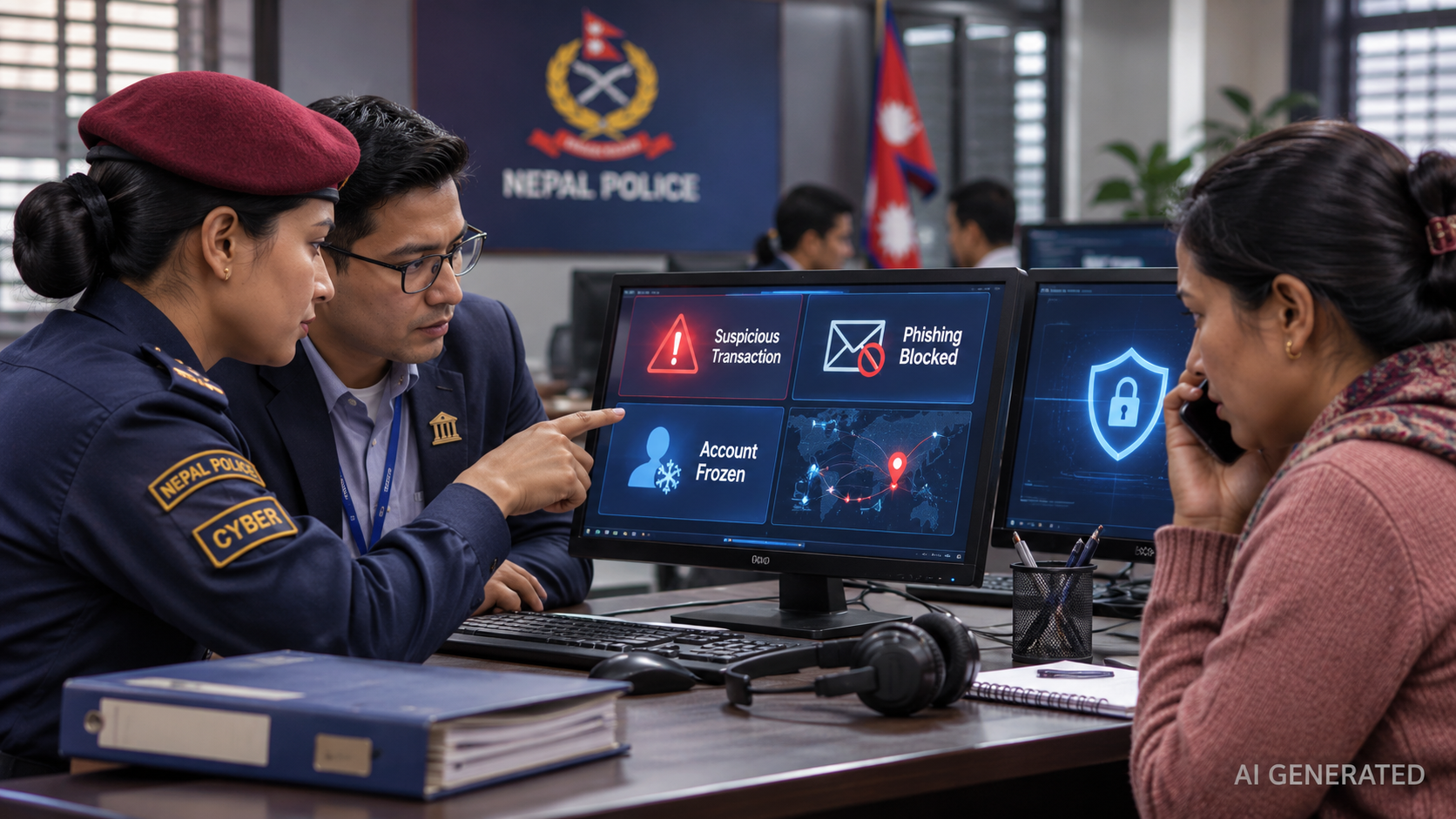
The Ministry of Home Affairs has issued the Integrated Anti-Cyber Scam Center (IACSC) Establishment and Operation Guidelines, 2083, establishing a framework to strengthen Nepal’s response to rising cyber-enabled financial crimes. The guidelines outline a centralized coordination mechanism involving Nepal Police, Nepal Rastra Bank, banks and financial institutions, payment service providers, telecommunications operators, and other regulatory agencies. The proposed center aims to address online investment scams, phishing, romance scams, fake employment offers, digital arrest fraud, cryptocurrency-related scams, and other emerging forms of cyber fraud.
Under the guidelines, the IACSC will facilitate rapid identification of suspicious transactions, freezing or lien-marking of potentially fraudulent accounts, tracing of stolen funds, and blocking of malicious mobile numbers, websites, domains, and IP addresses. The framework also provides for an Integrated Cyber Scam Center under Nepal Police, supported by coordinated participation from financial institutions and telecommunications service providers. A centralized case-tracking system will enable authorities to share information, monitor investigations, preserve digital evidence, and coordinate recovery efforts while ensuring appropriate confidentiality and data protection measures.
A significant feature of the guidelines is the introduction of a time-bound cyber scam response mechanism. As outlined in the operational workflow, reported incidents will undergo initial registration and classification within 0–10 minutes, followed by transaction tracing and identification of beneficiary accounts within 10–30 minutes. The framework also provides for account freezing, lien marking, and identification of linked accounts within 10–60 minutes, alongside expedited action to block suspicious SIM cards, phishing domains, and IP addresses. The system incorporates round-the-clock coordination, evidence preservation, investigation procedures, and feedback mechanisms to strengthen institutional accountability.
The guidelines further establish a Steering Committee and an Operations Coordination Committee to oversee implementation, interagency cooperation, resource management, and performance monitoring. They also emphasize public awareness, cybersecurity capacity development, regular reporting, and the protection of sensitive information. Through this initiative, the government seeks to create a unified national response system capable of minimizing financial losses, improving cybercrime investigations, protecting digital financial service users, and strengthening public confidence in Nepal’s expanding digital economy.