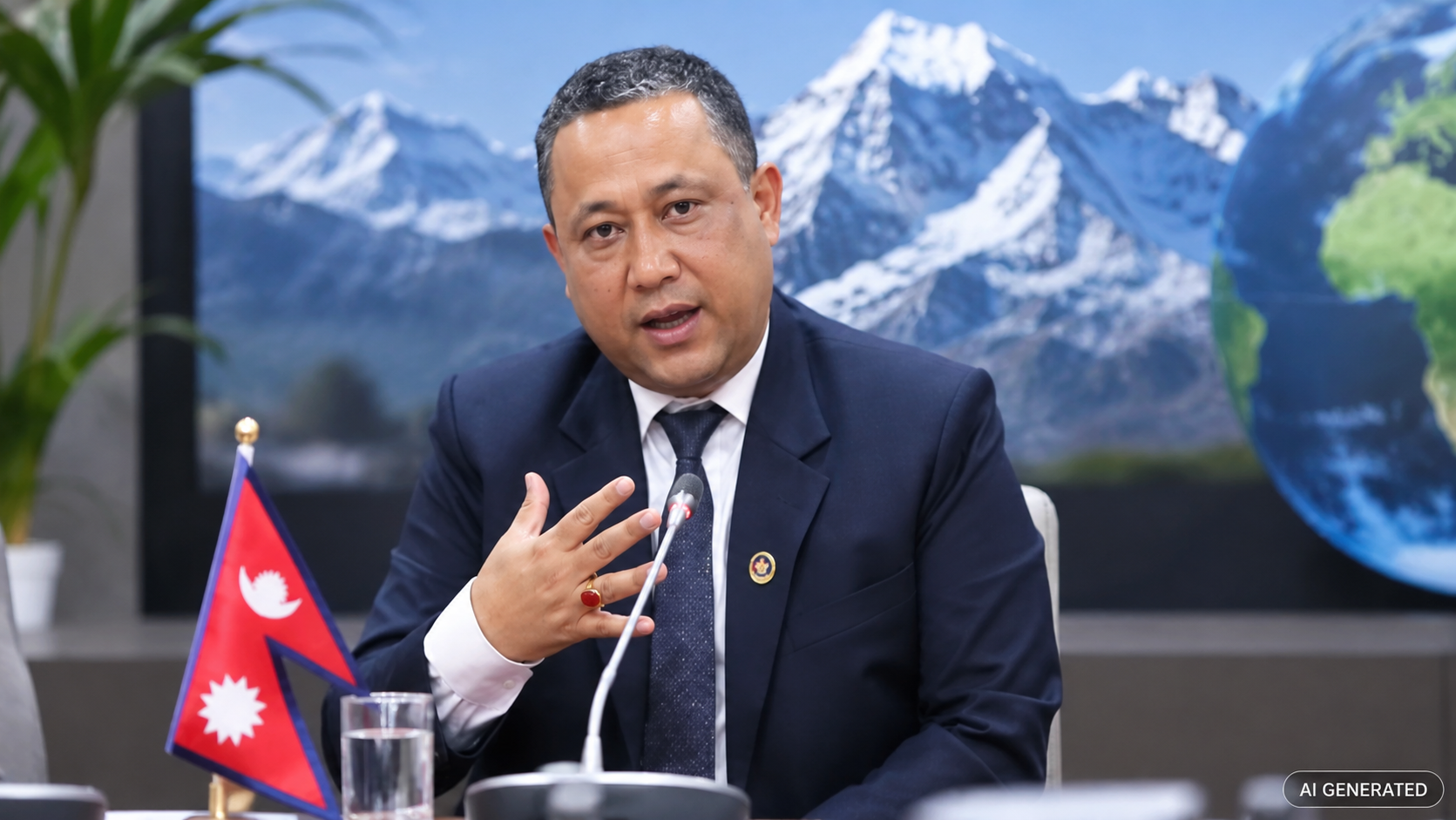
Nepal’s Minister for Foreign Affairs, Shisir Khanal, unveiled a five-point agenda for mountain climate resilience during the high-level event “Advancing the Mountain Agenda: Glaciers, Cryosphere and Resilience under Overshoot, Shared Responsibility and Sustainable Financing” held on November 12, 2026, in Antalya, Türkiye, on the sidelines of the 31st Conference of the Parties (COP31). Addressing international delegates alongside Minister for Agriculture, Forest and Environment Geeta Chaudhary, members of Nepal’s Parliament and senior officials, Khanal called for bringing mountain resilience to the centre of global climate negotiations. He acknowledged Tajikistan, Kyrgyzstan, Bhutan and Pakistan for their cooperation in advancing the shared mountain agenda. Highlighting that mountains cover approximately 27 percent of Earth’s land surface and sustain agriculture, clean energy, biodiversity and freshwater security, Khanal warned that rapidly retreating glaciers, thawing permafrost and cascading natural hazards threaten billions of people far beyond mountain regions. “When mountains are in crisis, humanity is in crisis,” he declared, emphasizing that the consequences of mountain ecosystem degradation extend across river basins, economies and international borders.
Referring to Nepal’s devastating August 26, 2026, “Himalayan Tsunami,” Khanal described how an abrupt high-altitude glacial and rock collapse unleashed enormous sediment-laden floodwaters through steep river valleys, claiming thousands of lives and destroying bridges and hydropower facilities. He argued that the disaster exposed the severe vulnerability of mountain communities despite their negligible contribution to global greenhouse gas emissions. The minister warned that temporary global temperature overshoot could cause permanent damage to glaciers and mountain ecosystems, making immediate action to limit warming essential. Presenting Nepal’s first priority, he called for ambitious climate mitigation through deep greenhouse gas emission reductions aligned with the 1.5°C temperature goal, including measures to reduce short-lived climate pollutants such as black carbon and protect fragile mountain environments. His second priority focused on predictable, accessible and grant-based climate financing to support adaptation, resilient infrastructure and sustainable livelihoods, stressing that vulnerable nations should not be forced to finance climate disaster recovery primarily through additional debt.
The foreign minister’s remaining three priorities addressed effective loss-and-damage financing, stronger scientific monitoring and sustained international political recognition of mountain-specific climate challenges. He urged international institutions to ensure that adequately financed loss-and-damage mechanisms deliver resources swiftly, directly and equitably to frontline mountain communities, enabling recovery and reconstruction before future disasters occur. Khanal also called for investments in high-altitude glacier monitoring, satellite observation networks, cross-border scientific cooperation and people-centred multi-hazard early warning systems capable of alerting vulnerable populations within minutes. He emphasized the importance of depoliticized regional data sharing, particularly across interconnected mountain river basins. As his fifth priority, Khanal demanded that mountain-specific risks receive structured and lasting recognition within the United Nations Framework Convention on Climate Change (UNFCCC) process, supported by dedicated high-level dialogue, technical cooperation and targeted financial arrangements. He stressed that mountain countries require sustained institutional attention rather than temporary recognition during individual climate conferences.
Concluding his address, Khanal called for the establishment of a formal “Sagarmatha to the Sea” partnership, connecting mountain and coastal communities through stronger international cooperation, knowledge exchange and collective advocacy. He identified Nepal’s Sagarmatha Call for Action as a roadmap for advancing mountain climate priorities and welcomed international support for the proposed UN Decade for Mountain Resilience. The foreign minister also highlighted the contributions of the Sagarmatha Sambaad in Nepal, Bishkek Mountain Dialogue and Dushanbe Glaciers Conference in building international momentum around mountain protection. He emphasized that the next stage must focus on delivering practical solutions through coordinated policies, sustainable financing and institutional commitments. The November 12 remarks present Nepal’s policy proposals and diplomatic priorities but do not confirm that COP31 has formally adopted the five-point agenda, established the proposed partnership or approved new financial commitments. Khanal concluded by urging participating countries to make COP31 a turning point for mountain resilience, warning that “Our melting mountains cannot wait for our negotiations to catch up with their changing reality.”