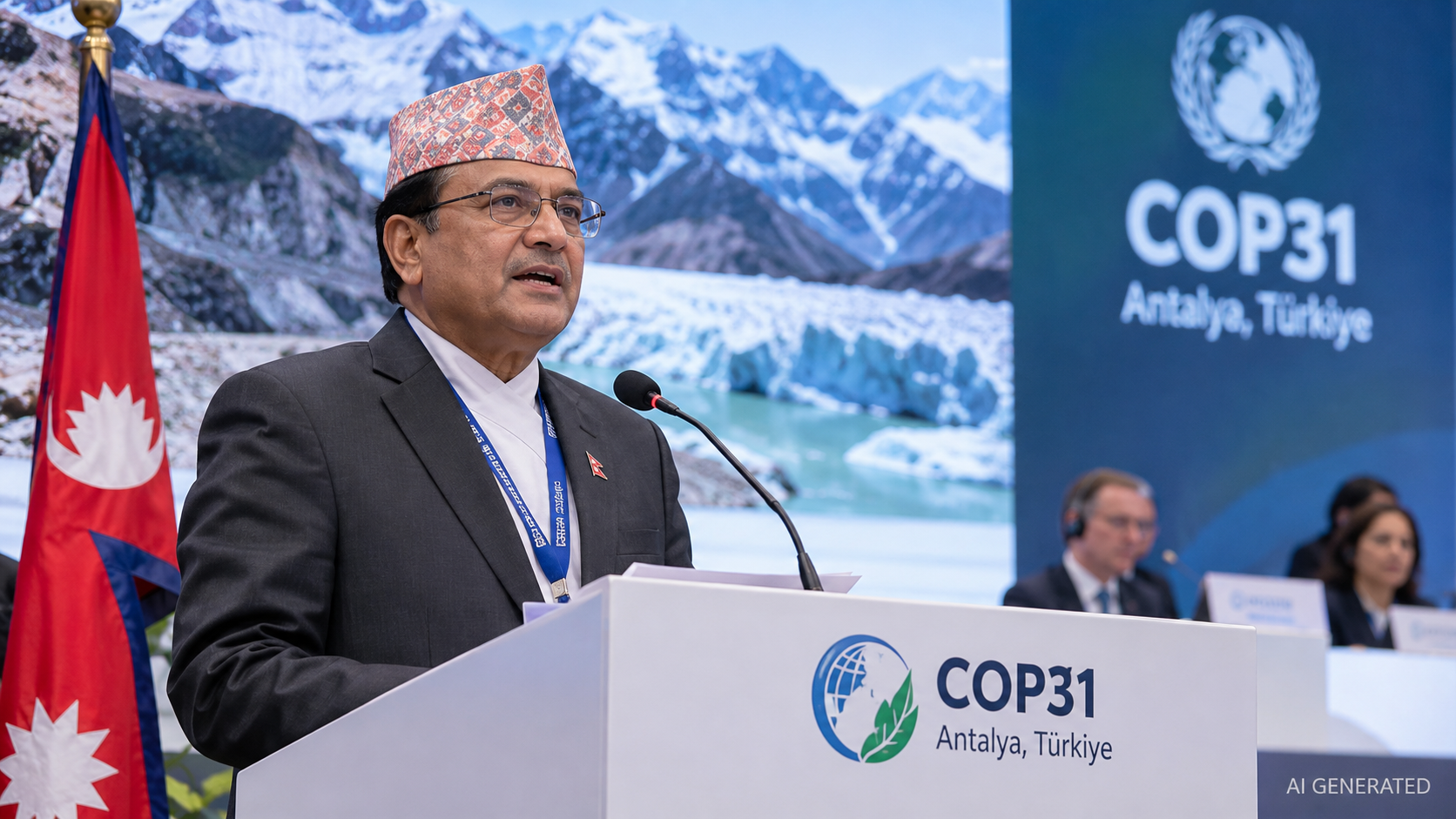
Nepal’s Minister for Foreign Affairs, Shisir Khanal, called for stronger international climate action and dedicated support for vulnerable mountain countries while addressing the Opening Plenary of the 31st Conference of the Parties (COP31) to the United Nations Framework Convention on Climate Change in Antalya, Türkiye, on November 9, 2026. According to a press release issued by the Ministry of Foreign Affairs, Khanal highlighted the unprecedented human, economic and environmental consequences of recent climate-related disasters in Nepal, particularly the catastrophic Bhotekoshi disaster. He urged participating countries to establish a dedicated work programme on “Mountain and Climate Change” within the COP31 process, emphasizing the importance of keeping the 1.5°C global warming limit within reach. The minister also called for integrating mountain-specific indicators into the Global Goal on Adaptation (GGA) and the New Collective Quantified Goal (NCQG) climate finance framework, while promoting international solidarity to help Nepal recover and rebuild more equitably.
Earlier in the day, Foreign Minister Khanal inaugurated the Nepal Pavilion at the COP31 venue, showcasing Nepal’s climate ambitions, biodiversity conservation achievements and community-level adaptation initiatives. Speaking at the inaugural ceremony, he drew international attention to the growing vulnerability of Himalayan ecosystems, particularly the risks associated with glacier retreat, cryosphere instability and climate-induced disasters. Referring to the recent Bhotekoshi catastrophe, Khanal emphasized that countries contributing relatively little to global greenhouse gas emissions often face disproportionate climate impacts. He reiterated Nepal’s demand for climate justice, accessible loss-and-damage funding and stronger international partnerships to protect mountain communities and downstream populations. The ceremony was also addressed by Minister of Health and Food Safety Neesha Mehta, House of Representatives Member Sagar Dhakal and other distinguished representatives, highlighting Nepal’s coordinated participation in the international climate negotiations.
A major highlight of Nepal’s first-day engagement was Khanal’s participation in the high-level side event “Strengthening Mountain Resilience through Adaptation Finance,” jointly hosted by Nepal, Bhutan and Kyrgyzstan in cooperation with the International Centre for Integrated Mountain Development (ICIMOD) and Zoï Environment Network. Addressing the event, the foreign minister stressed the substantial economic, physical and human losses caused by the recent disaster, which he referred to as the “Himalayan Tsunami.” He emphasized that nearly one-third of humanity directly depends on mountain ecosystems, making their protection a matter of global significance. Khanal urged governments and international institutions to incorporate mountain resilience more prominently into the UNFCCC negotiation process, expand predictable and accessible adaptation financing, and strengthen regional cooperation to address rapidly escalating climate threats. He underscored that effective climate action must extend beyond commitments and provide meaningful financial and technical support to vulnerable mountain nations.
On the diplomatic front, Foreign Minister Khanal held a bilateral meeting with Ethiopian Foreign Minister Gedion Timothewos, discussing climate cooperation and broader bilateral relations. Khanal expressed Nepal’s appreciation for Ethiopia’s sympathy and solidarity following the recent disasters and reaffirmed Nepal’s commitment to advancing equitable global climate action, shared environmental responsibility and multilateral cooperation, including engagement under Ethiopia’s next COP Presidency. The two ministers also exchanged views on strengthening cooperation in sustainable graduation from Least Developed Country (LDC) status, trade, air connectivity, tourism and people-to-people relations. The Ministry of Foreign Affairs stated that Khanal would continue participating in COP31 meetings and bilateral engagements the following day. The November 9 press release documents Nepal’s climate demands, international engagements and diplomatic discussions but does not announce newly approved climate financing, signed bilateral agreements or formal adoption of the proposed mountain climate work programme.