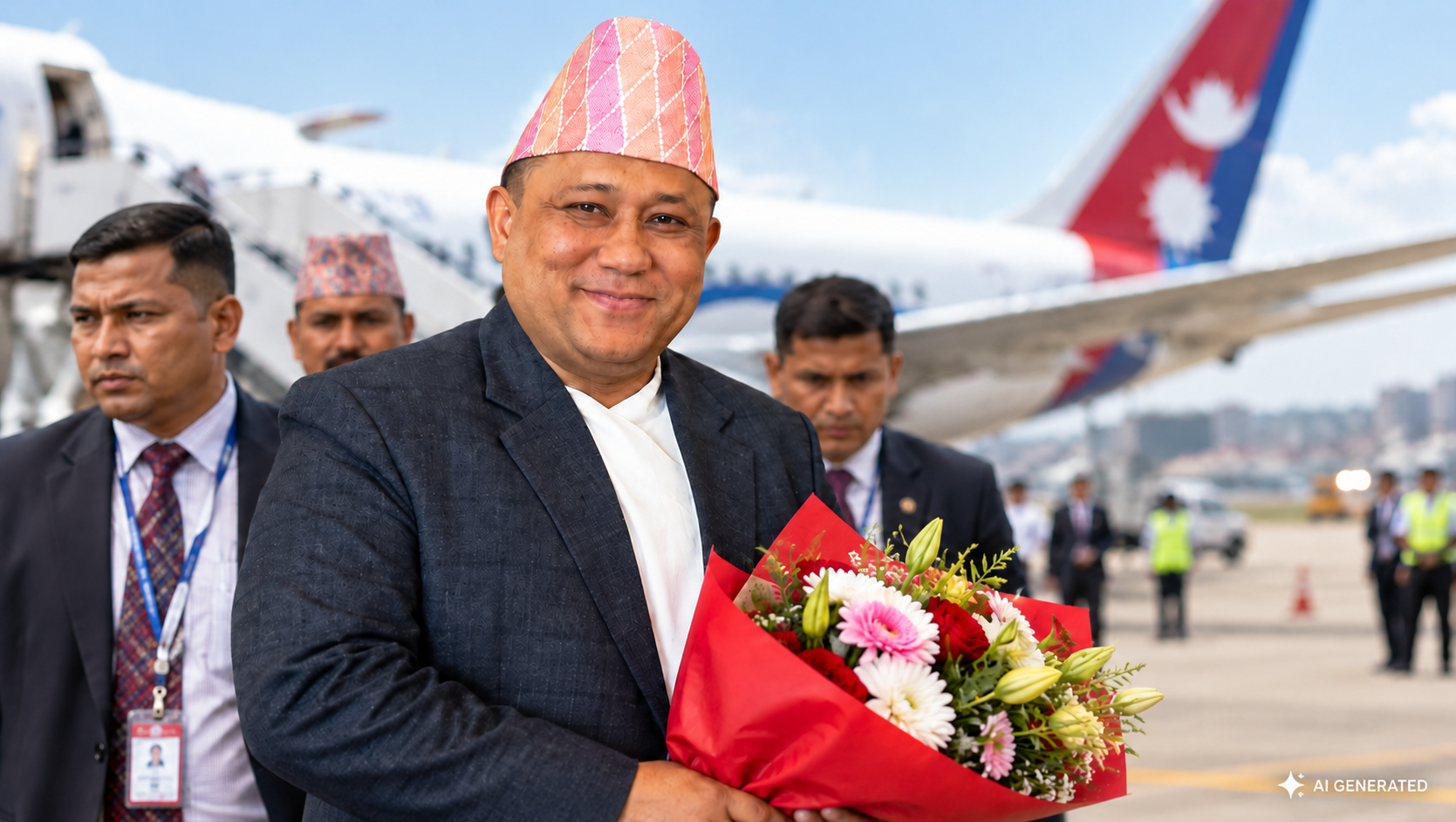
Foreign Minister Shishir Khanal has returned to Nepal after participating in the Pre-COP Leaders’ Event in Fiji and Tuvalu and completing an official visit to Australia. At the Pre-COP gathering, Nepal pushed four priorities for COP31: strict adherence to the 1.5°C limit, predictable grant-based adaptation finance, a fully capitalized and accessible Loss and Damage Fund, and a formal “Sagarmatha to the Sea” partnership linking mountain and ocean countries through knowledge, technology, early-warning systems and collective advocacy. The joint Taku Pakasoa Declaration also included reference to the loss of glaciers and ice sheets.
A major outcome of the Australia leg was the announcement of an additional AUD 15 million for Nepal’s flood relief and reconstruction, taking Australia’s total announced support to AUD 26 million when combined with the previously committed AUD 11 million. During talks with Australian Foreign Minister Penny Wong, Khanal also sought deeper cooperation on glacier monitoring, early-warning systems, climate-resilient infrastructure, education, student visas, Australian-accredited TVET, joint university research, investment and direct air connectivity between Nepal and Australia.
In Sydney, Khanal met New South Wales Premier Chris Minns and discussed disaster-management cooperation, technical exchanges and possible direct air connectivity involving the new Western Sydney International Airport. He also held meetings with Australia’s Governor-General Sam Mostyn, opposition figures and other political leaders, while raising Nepal’s climate priorities, student welfare and broader bilateral cooperation.
The visit also placed strong emphasis on the Nepali diaspora, with Khanal engaging communities in Melbourne, Sydney and Canberra and calling for their knowledge, capital and technology to support post-disaster reconstruction. The ministry’s press note says Nepal may require around USD 5 billion for reconstruction, while the minister also instructed the Nepali Embassy in Canberra to improve consular services and make economic diplomacy, investment promotion, trade and tourism more central to its work.