The Government of Nepal’s Ministry of Energy, Water Resources and Irrigation has published an 18-page report outlining 137 major achievements during the first six months following the formation of the current government, covering energy policy, hydropower development, irrigation, infrastructure and disaster preparedness. The report, dated Ashoj 28, 2083 BS, highlights progress on the Renewable Energy and Energy Efficiency Bill, which has received Cabinet approval and been submitted to Parliament, while the proposed Water Resources Bill has been forwarded to the Cabinet. The ministry has also prepared a National Energy Efficiency Action Plan and is developing a roadmap to restructure the Nepal Electricity Authority (NEA) into three separate companies for generation, transmission, and distribution and trading. On international energy cooperation, Nepal and India agreed to increase combined electricity import capacity from 1,000 MW to 1,400 MW and export capacity from 1,100 MW to 1,650 MW through key cross-border transmission lines. The report also confirms the issuance of 23 hydropower survey licences totaling approximately 1,623 MW, four generation licences totaling 30.59 MW, and seven new transmission licences.
The ministry reported substantial progress in irrigation infrastructure and agricultural water management, with approximately 3,815 hectares of additional land receiving irrigation facilities through major projects during the six-month period. This includes 1,300 hectares under the Sikta Irrigation Project, 1,155 hectares under the Mahakali Irrigation Project, 610 hectares under Badkapath, 600 hectares under Babai and 150 hectares under Rani Jamara Kulariya. The government has set a target to complete the Babai and Bheri–Babai irrigation projects within the next two fiscal years, while other national pride irrigation projects are targeted for completion within five years. The report also records progress in the 140 MW Tanahu Hydropower Project, where dam construction reached 62 percent, tunnel and powerhouse-related works reached 79 percent, and the associated 220 kV transmission line reached 82 percent. Meanwhile, the 1,063 MW Upper Arun and 828 MW Uttarganga hydropower projects received generation licences, and the NEA extended the Required Commercial Operation Dates of 27 hydropower projects totaling 540.47 MW.
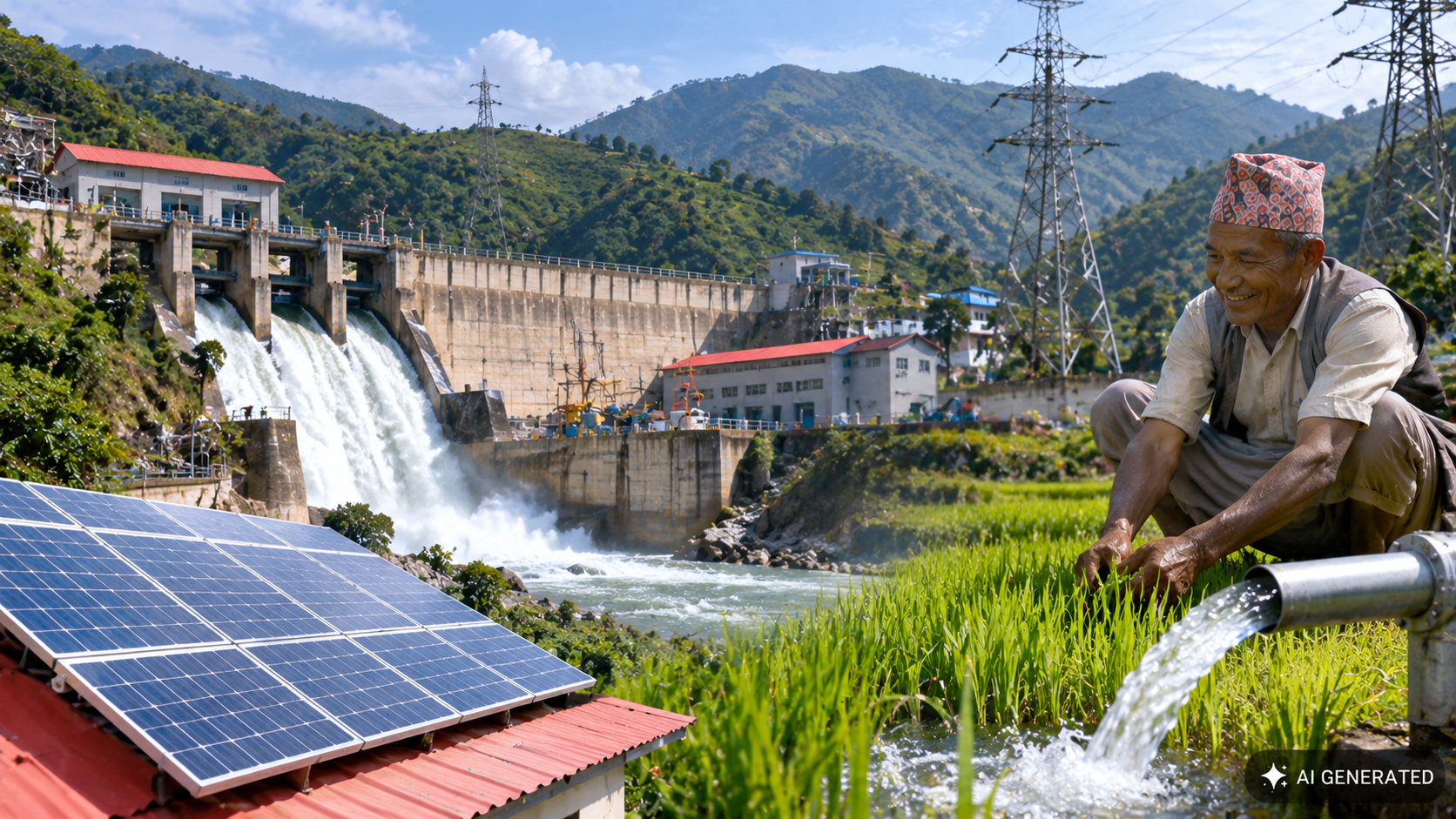
In renewable energy development, the Alternative Energy Promotion Centre (AEPC) reported installing approximately 18.58 MW of rooftop solar systems, generating 693 kW from micro and small hydropower projects and 841 kW from solar mini-grids. It also installed 315 solar irrigation pumps and distributed or installed 119,500 clean cooking technologies, including biogas plants, electric cooking stoves and improved cookstoves. The ministry submitted major international climate finance proposals, including USD 48.08 million for waste-to-energy development, USD 19.87 million for infrastructure recovery and loss-and-damage response, and USD 3 million for climate finance capacity development. In electricity infrastructure, the report highlights completion of the Bahrabise–Lapsiphedi 400 kV transmission line, partial operation of Bahrabise and New Khimti substations, and the commissioning of additional transmission and distribution facilities. The ministry also introduced AI-Sathi chatbot services, digital electricity payment systems and centralized inventory management, while advancing preparations for an AI Compute Centre.
The six-month review further highlights improvements in flood early warning, disaster response and climate resilience, particularly following the devastating Bhotekoshi floods. Authorities reported sending approximately 1.4 million SMS warnings during the Bhadra flood response, while another 1 million warnings were issued during the Ashoj rainfall emergency. The government extended major river flood forecasting from three to five days and nationwide flash flood forecasting from 24 to 48 hours, established additional monitoring facilities and expanded weather information services. The ministry also reported the preparation of a national electricity demand and consumption plan, institutional reforms, new electricity regulatory directives and continued research into hydropower infrastructure safety. The document presents a combination of completed achievements, ongoing construction, submitted funding proposals and future policy targets, rather than confirming that all announced initiatives have been fully implemented.