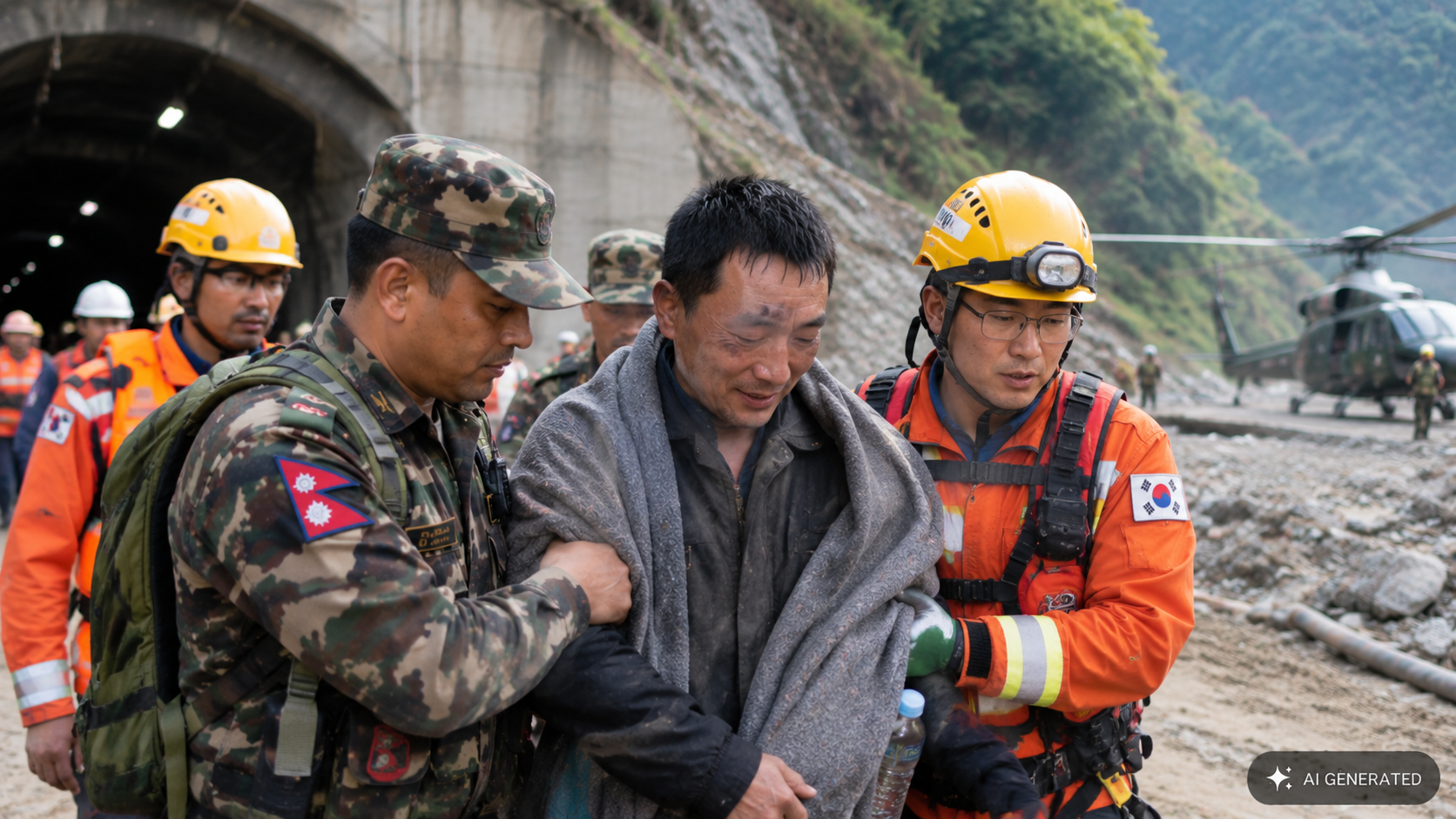
The Government of Nepal’s Ministry of Energy, Water Resources and Irrigation has reported a significant breakthrough in rescue operations following the devastating Bhotekoshi River flood on Bhadra 10, 2083 BS, which severely damaged hydropower infrastructure across Rasuwa, Nuwakot and Dhading districts. According to an official update issued on Bhadra 20, 2083 BS, a joint rescue team comprising the Nepal Army and South Korean disaster response specialists successfully rescued a Chinese national trapped inside the tunnel of the 216 MW Upper Trishuli-1 Hydropower Project on the 11th day after the flooding. The ministry confirmed that search and rescue operations were continuing for other missing individuals, with available personnel, equipment and technical resources being mobilized in consultation with specialists.
Meanwhile, 21 rescue personnel from the Nepal Army and Indian Army have been conducting difficult operations inside the tunnel of the Chilime Hydropower Project, despite adverse weather, challenging terrain and completely disrupted road access. Rescue teams have manually cleared approximately 100 metres of debris from a 250-metre-long tunnel, while preparations are underway to accelerate excavation using heavier machinery. Authorities have started constructing an access road to the powerhouse portal to transport a large excavator, while smaller helicopters continue delivering essential rescue equipment and supplies. The ministry also reported that, through the initiative of the Energy Minister, Switzerland provided Nepal with an advanced drone to assist tunnel inspections, risk assessments and search operations.
On electricity restoration, the ministry reported substantial progress by the end of Bhadra 20. According to the Nepal Electricity Authority (NEA), approximately 96 percent of Nuwakot and 78 percent of Rasuwa had regained electricity services, while supply had been restored to almost all affected areas of Dhading district. NEA teams continued working around the clock, including during public holidays, to repair damaged power infrastructure and reconnect remaining settlements. In areas where immediate restoration of the national grid was not possible, the ministry coordinated with the Alternative Energy Promotion Centre (AEPC) to provide emergency solar lighting systems and other alternative energy solutions.
The ministry further stated that joint rescue operations involving Nepali, Indian and Korean specialists, alongside hydropower project engineers, were continuing inside flood-damaged tunnels. Technical teams were conducting reconnaissance, drilling, controlled blasting and debris removal using excavators, back loaders, Bobcat machines and drones to reach inaccessible sections and locate missing workers. The press release, issued by Assistant Spokesperson Shaligram Bhandari, emphasizes the government’s commitment to completing rescue operations and restoring reliable electricity services. The document confirms ongoing search efforts and partial electricity restoration but does not provide a final count of missing persons or a definitive timeline for completing all rescue and reconstruction activities.