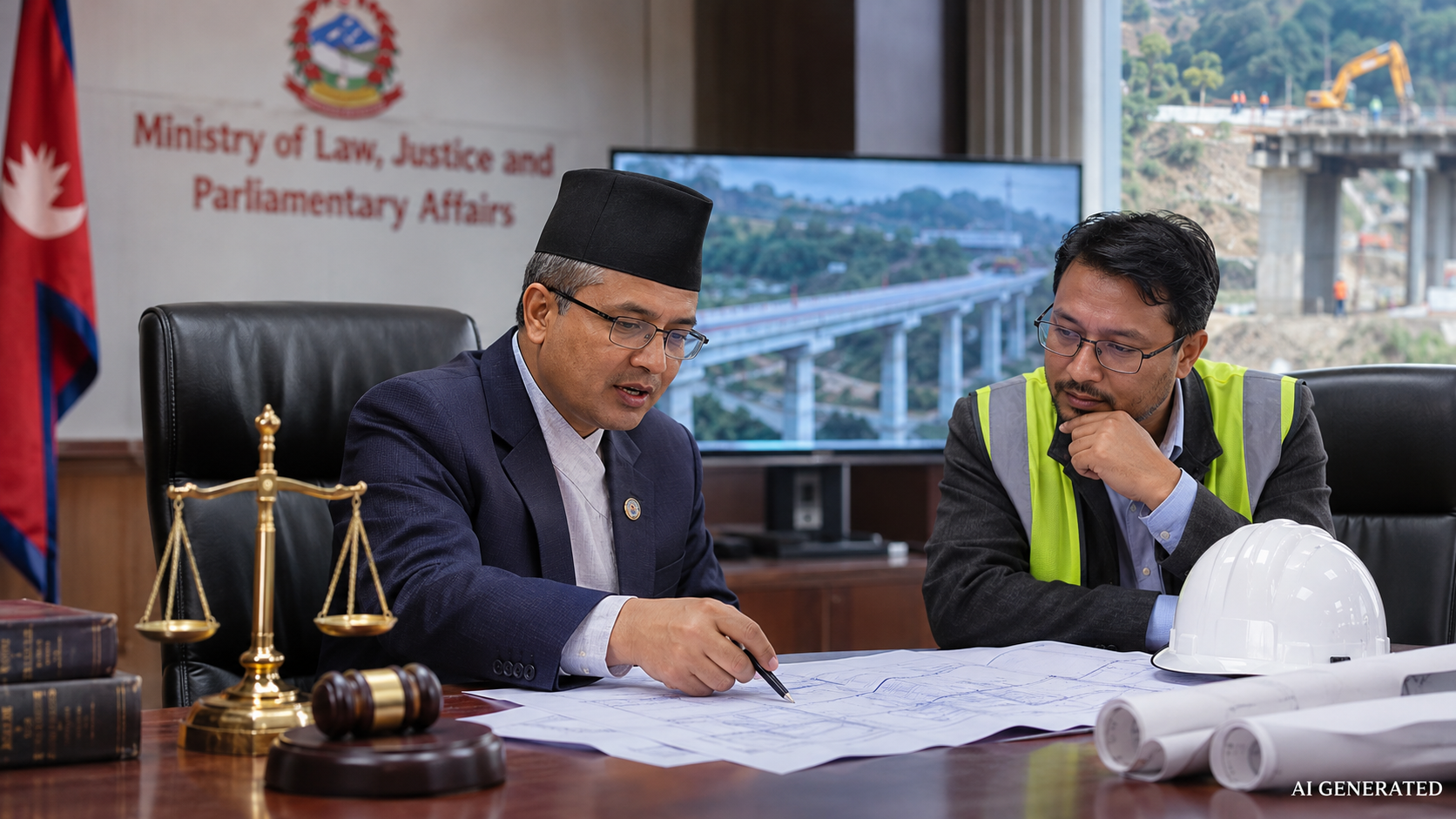
The Ministry of Law, Justice and Parliamentary Affairs has invited public feedback on the draft Infrastructure Tribunal Bill, 2083, which seeks to establish a dedicated tribunal for resolving legal disputes involving infrastructure development and construction projects. According to the ministry’s public notice, the proposed legislation has been released for stakeholder consultation under Section 6(2) of the Legislation Act, 2081. The bill aims to address prolonged litigation, contractual disagreements, and administrative obstacles affecting infrastructure projects, including roads, hydropower and electricity transmission lines, airports, information technology infrastructure, urban development, and water supply systems. Interested individuals and organizations have been invited to submit their opinions within seven days of the notice’s publication through the government’s legislative feedback portal or by email.
Under the proposed legislation, the government would establish an Infrastructure Tribunal consisting of three members, including a chairperson appointed from among High Court judges on the recommendation of the Judicial Council, one expert in economics, management, commercial law or finance, and one engineering expert. The chairperson would serve for the period determined by the government on the Judicial Council’s recommendation, while the two expert members would have five-year terms, with eligibility for one reappointment. The tribunal’s headquarters would be located in Kathmandu Valley, with provisions allowing additional tribunals or regional jurisdictions if necessary. Its jurisdiction would cover disputes related to public procurement, construction contracts, performance guarantees, advance-payment guarantees, public-private partnerships, right-of-way issues, compensation, project management, and other infrastructure-related matters specified by law.
The bill proposes a 90-day deadline for deciding cases after registration, along with provisions for interim orders, mediation, virtual hearings, and expedited proceedings. It would allow parties to seek reconsideration of tribunal decisions before a dedicated Supreme Court bench within 30 days, while petitions for mediation or settlement could be submitted during proceedings. The draft also contains provisions designed to prevent unnecessary suspension of infrastructure construction, stating that project activities should not be halted unless ordered by a court or tribunal. Where parties disregard tribunal orders or obstruct proceedings, the proposed law provides for enforcement measures, including financial penalties. The framework also outlines procedures for transferring eligible pending cases from existing courts to the specialized tribunal and establishing dedicated arrangements for handling appeals and reconsideration.
The ministry has requested stakeholders to examine the proposed bill and provide recommendations through the official legislative consultation portal at https://lawfeedback.moljpa.gov.np/ or by emailing lawdrafting@moljpa.gov.np. The draft also proposes amendments to the Mediation Act, 2068, to align existing dispute-resolution provisions with the proposed tribunal’s authority. By introducing specialized judicial expertise and defined case-resolution timelines, the government aims to improve the efficiency of infrastructure dispute settlement and reduce delays that can increase project costs. The legislation remains a draft and has not yet been enacted, meaning the proposed tribunal, its powers, and its procedural deadlines will depend on completion of the legislative process.