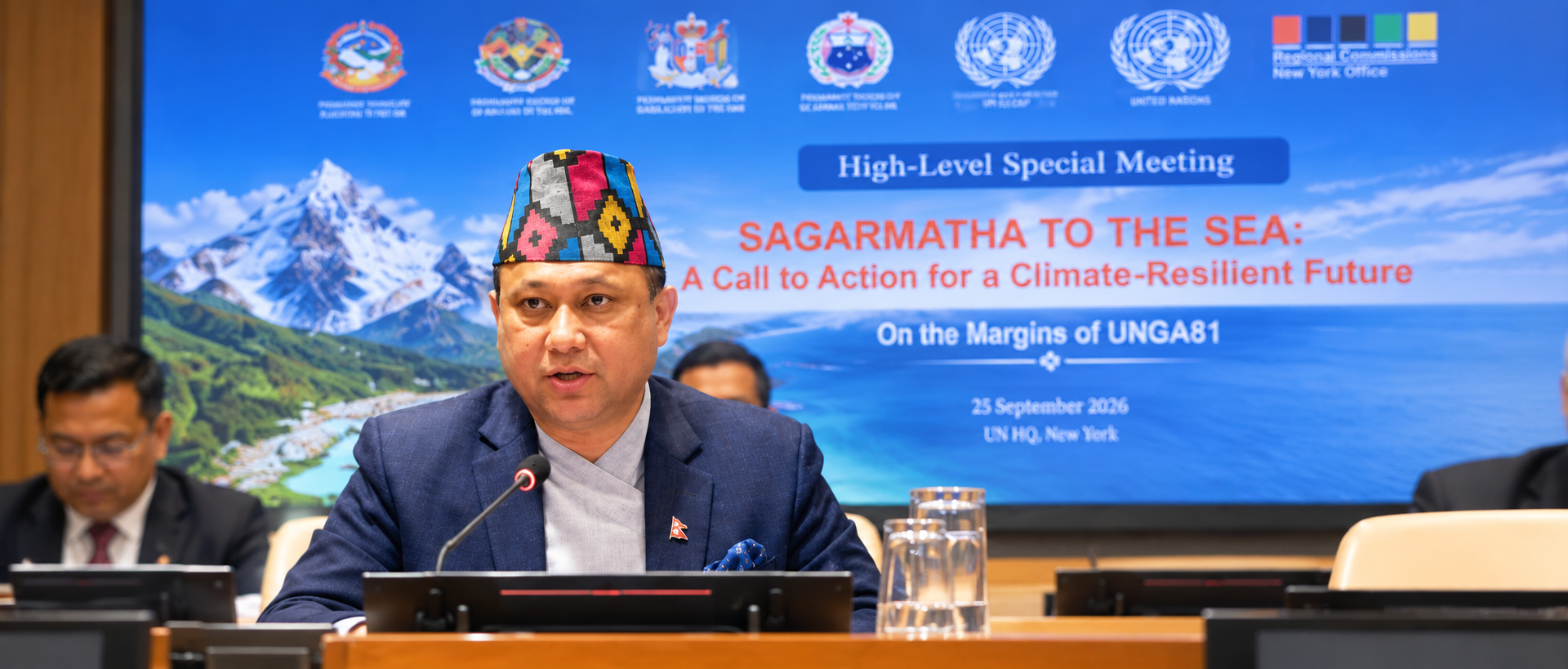
New York, September 25: Nepal has urged the international community to recognise the interconnected impacts of climate change from the world’s highest mountains to its oceans. Addressing the high-level special event “Sagarmatha to the Sea: A Call to Action for a Climate-Resilient Future” at the United Nations Headquarters in New York, Foreign Minister Shisir Khanal said climate systems do not recognise political boundaries and that changes in Himalayan glaciers have consequences far beyond mountain communities.
Khanal said Nepal has lost close to one-third of its ice over the past three decades, affecting river flows and threatening downstream livelihoods, while island and coastal countries face rising seas, erosion and displacement. Referring to the August 26 disaster in Nepal, he said a massive collapse of rock and glacier ice in the Langtang region triggered what he described as a “Himalayan Tsunami,” causing loss of life and extensive destruction of homes and critical infrastructure.
The Foreign Minister presented five proposals for global climate action: recognising the ecological connection between mountains, freshwater systems and oceans; giving mountains greater prominence in climate processes; keeping the 1.5°C temperature goal within reach through faster emission reductions and transition away from fossil fuels; strengthening early-warning systems, resilient infrastructure and scientific cooperation; and ensuring adequate, predictable and accessible climate finance, technology and capacity-building for developing countries. He also called for the Fund for Responding to Loss and Damage to be sufficiently capitalised and accessible to vulnerable countries.
The event was organised with partners including Bhutan, Maldives, New Zealand, Samoa and Tajikistan, along with UN agencies including UNEP and ESCAP. Khanal said Nepal, where forests cover around 46 percent of the territory, is expanding clean hydropower and electric mobility while maintaining community-led conservation efforts. He also said Nepal plans to host the second edition of the Sagarmatha Sambaad next year and envisages “Sagarmatha to the Sea” as a platform for international knowledge-sharing, partnership and practical climate cooperation.